
Published: November 7, 2026 | Last updated: November 7, 2026
If you are wondering how to follow up with investors after a pitch, the best approach is to send a short, personalized thank-you within 24 hours and include any information you promised during the meeting. If the investor does not reply, follow up again after about 5–7 business days with a concrete update, requested material, or a clear next step rather than simply asking whether they have decided.
This guide is for Pakistani founders who want to follow up professionally without sounding desperate or pushy. It covers timing, email and WhatsApp etiquette, what to say after silence, when to stop following up, and practical templates you can adapt for different investor responses. If you are still building your investor pipeline, read the ORLUMENS guide on How to Find Investors & Get Startup Funding in Pakistan.
Quick Answer: How Should You Follow Up With an Investor?
- Follow up within 24 hours: Thank the investor, recap the key discussion, and send any promised documents or answers.
- Follow up again after 5–7 business days if there is no reply: Add something useful instead of sending a generic “just checking in” message.
- Include one clear next step: Ask for a specific action, such as feedback, another meeting, or confirmation that they want additional information.
- Use the channel the investor already prefers: Email should usually remain the default; use WhatsApp or LinkedIn when the investor has already communicated with you there or invited you to.
- Know when to stop: After two unanswered follow-ups, it is usually better to move on unless you have a meaningful new milestone or update worth sharing.
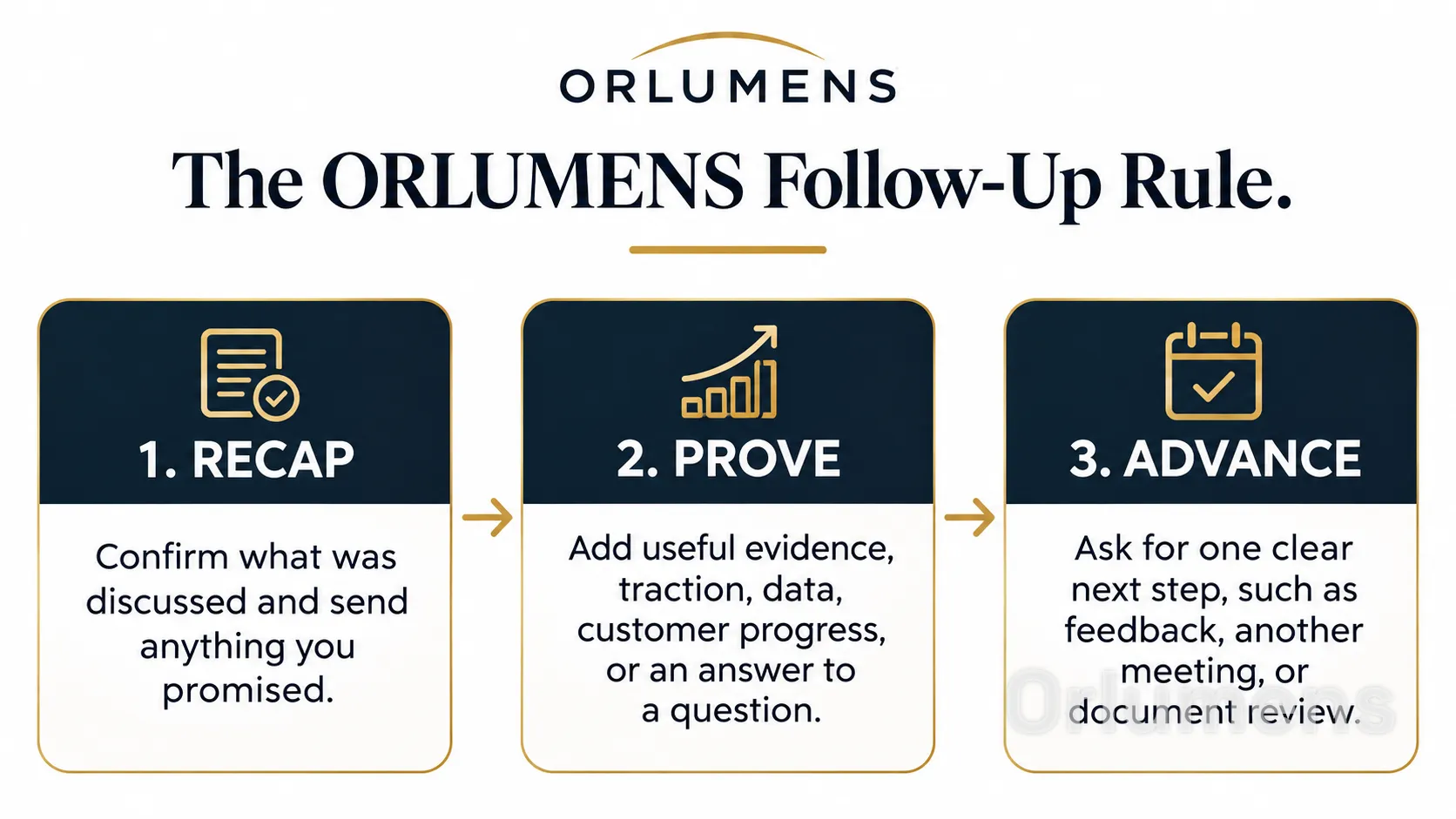
The ORLUMENS Follow-Up Rule: Recap → Prove → Advance
A strong investor follow-up should do three things: recap the conversation, prove progress with something useful, and advance the relationship toward one clear next step.
- Recap: Confirm what was discussed and send anything you promised.
- Prove: Add relevant traction, data, customer progress, or an answer to a question.
- Advance: Ask for one clear next step, such as feedback, another meeting, or a document review.
The goal is simple: every follow-up should add value instead of merely reminding the investor that you are waiting.
How Soon Should You Follow Up After an Investor Pitch?
Send a short thank-you within 24 hours of the meeting, especially if you promised documents, numbers, or follow-up information. If there is no response, a second message after about 5–7 business days is usually reasonable. A final check-in around the two-week mark can close the loop without making the outreach feel repetitive or pushy.
| Timing | What to do | Purpose |
| Day 0–1 | Send a thank-you, recap the discussion, and share anything you promised | Show professionalism and keep momentum |
| Day 5–7 | Send a brief follow-up with a useful update, answer, or clear next step | Re-engage without simply saying “just checking in” |
| Around Day 12–14 | Send the second and final follow-up if there is still no reply | Close the loop professionally and leave the relationship open |
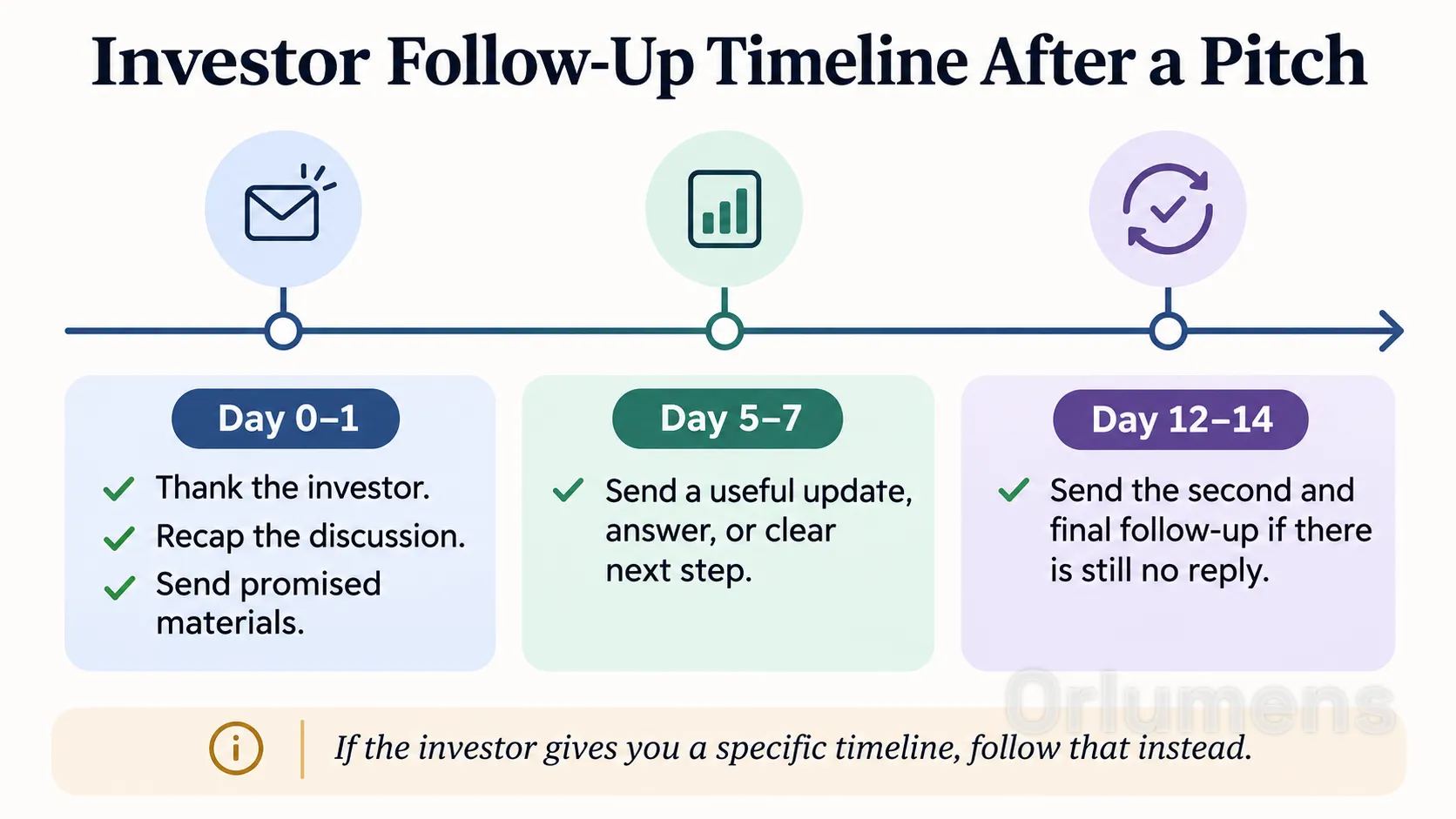
These timings are guidelines, not fixed rules. If the investor gave you a specific timeline—such as “follow up next week” or “send this after our partner meeting”—follow that instead.
If the investor is already in due diligence, use the timeline agreed with them instead of the general 5–7 day rule. Active diligence usually requires faster, stage-specific communication because the investor may be waiting for documents, financial information, customer references, or answers to specific questions.
For Pakistani founders, also account for local business rhythms. Investor responses may slow around Ramadan, Eid holidays, public holidays, major industry events, or year-end schedules. In those cases, give the investor more space rather than assuming silence means rejection.
The strongest follow-up is not the fastest one. It is the one that arrives at the right time with something useful to add.
What Should You Say in an Investor Follow-Up Email?
A strong investor follow-up email should do four things: thank the investor, reference one specific point from the conversation, reinforce one credible proof point, and ask for one clear next step. Keep it short enough to scan and avoid repeating your entire pitch deck.
A useful structure is:
- Thank them: Acknowledge their time.
- Reference the conversation: Mention one specific topic, question, or concern they raised.
- Add one proof point: Share relevant traction, data, customer progress, or the information they requested.
- Ask for one next step: Request feedback, another meeting, or confirmation that they want more information.
Template 1: 24-Hour Thank-You Email
Subject: Thank you — [Company Name]
Hi [Investor Name],
Thank you for taking the time to speak with me today. I appreciated your questions about [specific topic discussed].
As mentioned, [one concise proof point or requested detail].
I’ve attached/shared [deck, data, or information promised]. If it makes sense, I’d be happy to continue the conversation and answer any additional questions.
Best,
[Founder Name]
Template 2: 5–7 Day Update Email
Subject: Quick update — [Company Name]
Hi [Investor Name],
I wanted to follow up on our conversation last week. Since we spoke, [one meaningful update, milestone, customer win, metric, or answer to a question].
Given your interest in [specific topic], I thought this would be useful context.
Would a 20-minute follow-up next week be useful, or would you prefer I send anything else first?
Best,
[Founder Name]
The key is to avoid empty follow-ups such as “just checking in.” Every message should either add useful information, answer a question, or make the next step easier.
Is It Okay to Follow Up With an Investor on WhatsApp?
Yes—but only when WhatsApp is already an accepted communication channel between you and the investor. If the investor gave you their number, messaged you first, or said “send it on WhatsApp,” a short follow-up there can be appropriate. If you only have their email or found their number elsewhere, use email instead.
For Pakistani founders, WhatsApp may already be part of the conversation with an investor, but that does not make unsolicited messaging appropriate. A good rule is to match the channel the investor has already opened. If the relationship started over email, keep the formal follow-up there unless the investor suggests moving to WhatsApp.
Use WhatsApp for a brief reminder, requested document, meeting confirmation, or concise update—not a full pitch deck pasted into chat.
Template 3: Short WhatsApp Follow-Up
Hi [Investor Name], this is [Your Name] from [Company]. Thank you again for your time on [day/meeting]. I’ve sent the [deck/data/information] we discussed. We’ve also [one brief relevant update]. Happy to share anything else you need, and I’d be glad to continue the conversation when convenient.
If the investor does not reply, avoid sending repeated WhatsApp messages across multiple channels. One professional follow-up is better than creating pressure through WhatsApp, email, LinkedIn, and calls at the same time.
What If an Investor Doesn’t Reply After a Pitch?
An investor’s silence does not automatically mean rejection. They may be reviewing other deals, handling portfolio work, waiting for an internal discussion, or simply dealing with a crowded inbox. The best response is not to increase pressure—it is to follow up in a structured way and add something useful each time.
A simple three-touch sequence works well:
- Touch 1 — Thank-you within 24 hours:
Recap the conversation and send any material or answers you promised. - Touch 2 — Value-add follow-up after 5–7 business days:
Share one useful update, such as new traction, customer progress, requested data, or a clear answer to something discussed. - Touch 3 — Final check-in around 1 week later
Keep it brief, acknowledge that they may be busy, and close the loop without applying pressure. Stripe similarly recommends adding new information in follow-ups rather than sending empty “bump” messages.
Template 4: Final “Closing the Loop” Message
Subject: Closing the loop — [Company Name]
Hi [Investor Name],
I wanted to follow up one final time after our conversation about [Company].
Since we spoke, [one short relevant update, if available].
I understand priorities and timing can change, so I’ll close the loop here for now. If it makes sense to reconnect later, I’d be happy to keep you updated as we reach new milestones.
Thanks again for your time and feedback.
Best,
[Founder Name]
A professional closing message leaves the relationship intact and gives you room to reconnect later with meaningful progress.
How Many Times Should You Follow Up With an Investor?
In most cases, two follow-ups after your initial post-meeting message are enough. If the investor has not replied after those attempts, continuing without new information can start to feel like pressure rather than persistence. Current Stripe guidance similarly recommends moving on after two unanswered follow-ups unless you have something genuinely new to share.
This cap applies to normal post-pitch silence; if the investor is in active due diligence or has given you a specific timeline, follow that process instead.
Avoid:
- “Just checking in” emails with no new information
- Daily or every-other-day messages
- Guilt-tripping, such as “I haven’t heard back from you”
- Messaging across email, WhatsApp, LinkedIn, and phone at the same time
- CC’ing multiple partners at the fund to force a response
The goal of a follow-up is to make the investor’s next decision easier—not to make yourself impossible to ignore.
There are exceptions. If the investor explicitly asks for weekly updates, enters due diligence, or gives you a specific follow-up date, follow that process instead. Stripe notes that cadence should change depending on where the investor is in the fundraising pipeline.
When Should You Stop Following Up?
Stop active follow-up when you have sent two thoughtful follow-ups with no response, the investor clearly says the company is not a fit, or their investment thesis no longer matches your stage, sector, geography, or round. Moving on protects your time and helps keep the relationship professional.
You should also step back when:
- The investor gives you a clear “no”
- They repeatedly postpone without suggesting another step
- They tell you to return after reaching a specific milestone
- Your round or company direction changes enough that the original conversation is no longer relevant
Stopping does not mean burning the relationship.
If an investor says “not now,” ask whether they would be open to a future update. Then reconnect only when you have a meaningful reason—such as stronger revenue, a major customer, new market traction, or another milestone. Stripe explicitly recommends keeping the door open with useful milestone updates rather than repeatedly asking for another meeting.
Common Follow-Up Mistakes
Investor follow-up should make the next step easier, not create pressure. Avoid these common mistakes:
- Sending “just checking in” messages: Add a useful update, answer, or specific next step instead.
- Following up too frequently: Give the investor enough time to respond before sending another message.
- Repeating the same pitch: Use follow-ups to add new context, traction, or information.
- Using every channel at once: Do not email, WhatsApp, call, and message on LinkedIn simultaneously.
- Guilt-tripping the investor: Keep the tone professional even when you have received no response.
- Making the next step unclear: End with one simple request, such as feedback, another meeting, or confirmation that more information is needed.
The best follow-up creates clarity, value, and an easy next action.
FAQs
How soon should you follow up after an investor pitch?
Send a short thank-you within 24 hours of the pitch, especially if you promised documents or additional information. If there is no reply, follow up again after about 5–7 business days. If the investor gave you a specific timeline during the meeting, follow that timeline instead of using a generic schedule.
How many times should you follow up with an investor?
Two thoughtful follow-ups after your initial post-meeting message are usually enough if the investor remains silent. Each message should add useful information rather than simply repeating your request. If the investor explicitly asks for updates or gives you a future date to reconnect, follow their preferred cadence instead.
What should you say in a follow-up email to an investor?
Thank the investor for their time, mention one specific point from your conversation, include one relevant proof point or requested update, and finish with a clear next step. Keep the email concise. Avoid repeating your full pitch deck or sending a vague “just checking in” message with no new information.
Can you follow up with an investor on WhatsApp?
Yes, if the investor has already used WhatsApp with you, shared their number for communication, or invited you to message them there. Otherwise, email is usually the safer default. Keep WhatsApp follow-ups short and professional, and avoid sending repeated messages across WhatsApp, email, LinkedIn, and phone at the same time.
What if the investor doesn’t reply after the pitch?
Silence does not always mean rejection. The investor may be busy, reviewing other deals, waiting for an internal discussion, or delaying the decision. Follow up with something useful after a reasonable interval. If two thoughtful follow-ups receive no response, close the loop professionally and focus on other relevant investors.
When should you stop following up with an investor?
Stop active follow-up after two unanswered follow-ups, when the investor clearly says the company is not a fit, or when they ask you to return after reaching a specific milestone. Leave the relationship open by thanking them and reconnecting later only when you have meaningful progress or genuinely relevant new information.
How to follow up with investors after a pitch without sounding pushy?
The best way to follow up with investors after a pitch without sounding pushy is to keep each message short, relevant, and useful. Thank the investor, reference the previous conversation, add a meaningful update or requested information, and ask for one clear next step. Avoid repeated “just checking in” messages or contacting the investor across multiple channels at the same time.
Conclusion
A strong investor follow-up follows a simple rule: recap the conversation, add useful proof, and move toward one clear next step. Send the first message promptly, follow up with value rather than pressure, and know when to close the loop professionally.
For Pakistani founders, understanding how to follow up with investors after a pitch can help maintain momentum, protect professional relationships, and make each next step clearer. The goal is not to chase every investor indefinitely—it is to build credible, long-term investor relationships.
Sources
- How to Reach Out to Investors for Your Startup: Cold Emails, Warm Intros, and Follow-Ups — Stripe
- How to Track and Manage Your Startup Fundraising Pipeline — Stripe
About the Author
Noor ul Hassan
Noor ul Hassan writes for ORLUMENS, Pakistan’s networking and business intelligence ecosystem for founders, CEOs, investors, and business leaders. He writes about business networking, founder stories, startup funding, and investor access, with a focus on helping founders in Pakistan and other emerging markets build the relationships that growth depends on.
His ORLUMENS guides include How to Find Investors & Get Startup Funding in Pakistan.