
To find investors and get startup funding in Pakistan, make your startup investor-ready, shortlist investors that match your stage, sector, and cheque size, approach them through warm introductions or personalized outreach, and explore programs such as the Pakistan Startup Fund, incubators, and accelerators.
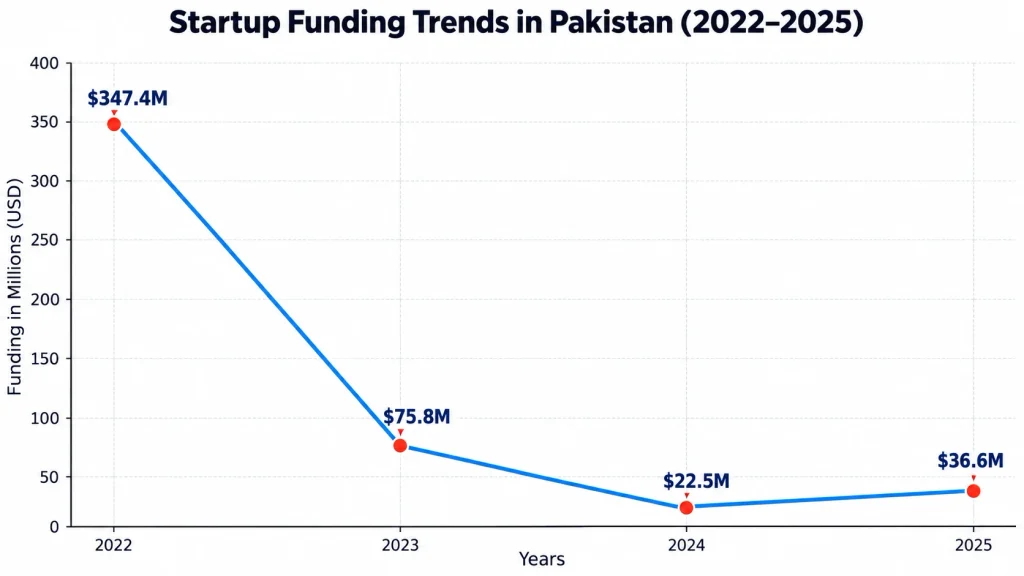
Finding startup investors in Pakistan can be difficult for first-time founders because the market is selective. Pakistani startups raised $36.6 million in 2025, up from $22.5 million in 2024, but still far below the $347 million raised in 2022. Capital is available, but investors increasingly look for traction, execution, and credible growth potential rather than ideas alone.
This step-by-step guide covers where to find investors in Pakistan, how to approach them, what they expect from founders, and what to prepare before your first meeting. By the end, you will know which investors fit your stage and how to reach them.
Why Is It Difficult to Find Startup Investors in Pakistan?
Pakistan’s venture capital market is relatively small, and funding has become more selective since the 2022 startup boom. Pakistani startups raised about $347.4 million in 2022, but funding dropped to around $75.8 million in 2023 and just $22.5 million in 2024. Although disclosed equity funding recovered to $36.6 million in 2025, investment activity remained far below earlier peak levels.
In this environment, founders generally need to show more than a promising idea. Investors increasingly look for evidence of execution, such as a working product, paying customers, or other market validation, revenue growth, customer retention, and disciplined use of capital.
The practical lesson: a good idea can start the conversation, but traction and execution make a startup more convincing to investors.
What Funding Options Are Available for Startups in Pakistan?
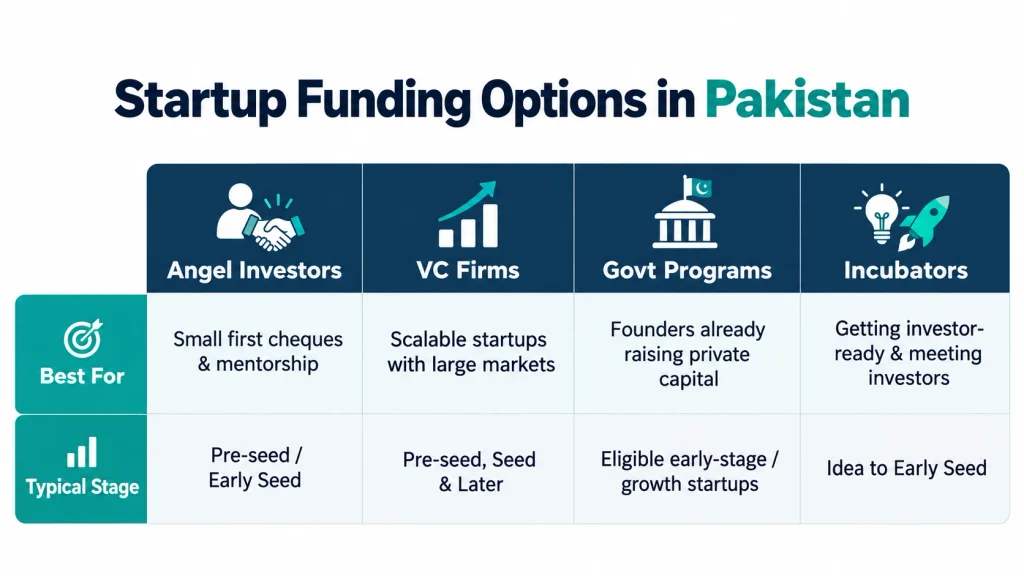
Pakistani startups can raise money from four main sources: angel investors, venture capital firms, government-backed programs, and incubators and accelerators. Founder networks and events help you reach them. The right choice depends on your stage, how much you need, and whether you want equity, a grant, or mentorship.
| Source | Best for | Typical stage | Example |
| Angel investors | Small first cheques and mentorship | Pre-seed, early seed | Individual angels and angel networks |
| Venture capital firms | Scalable startups with large markets | Pre-seed, seed and later | i2i Ventures, Indus Valley Capital |
| Government-backed programs | Founders already raising private money | Startups already raising private capital | Pakistan Startup Fund (Ignite) |
| Incubators and accelerators | Getting investor-ready and meeting investors | Idea to early seed | NICAT |
| Founder networks and events | Warm introductions | Any stage | Demo days, startup communities |
1. Angel investors
Angels invest their own money in early-stage companies. They are most useful when you are building an MVP, validating your first market, or looking for a relatively small first round. Beyond money, they often help with mentorship, hiring, and introductions to later investors. They typically look for a strong founding team, a clear problem, early validation, and a scalable business model.
2. Venture capital firms
VC firms invest professional capital in startups with high growth potential, usually in exchange for equity. Two Pakistan-focused examples:
- i2i Ventures invests in pre-seed and seed-stage Pakistani startups, with initial cheques typically between $250,000 and $500,000. Companies it has backed include DealCart, Rider, Tazah and Metric.
- Indus Valley Capital is an early-stage fund that backs Pakistani startups. Companies it has backed include Bazaar and BridgeLinx.
3. Government-backed programs
The Pakistan Startup Fund, run by Ignite under the Ministry of IT & Telecom, offers a non-equity grant of up to 30% of your total round size, ranging from $50,000 to $1 million.
Before you apply, note that:
- the grant is paid as the last cheque, so you need to secure (or be close to securing) the private investment first;
- your company must be registered in Pakistan and less than 10 years old;
- applications are rolling, so you can apply at any time.
This means you can raise part of your round without giving up equity.
4. Incubators and accelerators
Incubators help founders become investor-ready and introduce them to investors. NICAT supports aerospace, deep tech, AI and robotics startups with mentorship, market access and capital connections.
Founder networks and events (how to reach investors)
Demo days, startup competitions and founder communities are where many warm introductions start. They rarely lead to a cheque on their own, but they help you reach the right people.
Which should you start with? If you are pre-seed, begin with angels, incubators, and founder networks. If you already have traction, shortlist VC firms and check your eligibility for the Pakistan Startup Fund. See Step 3 below to build your investor shortlist.
How to Get Startup Funding in Pakistan: Step-by-Step Roadmap
Follow these 9 steps in order. Each step ends with a “Done when” check, so you know you are ready to move on. Investors in Pakistan are selective: startup funding was $36.6 million in 2025, far below the 2022 peak, so preparation matters.
Step 1: Make Your Startup Investor-Ready
Many investors will expect formal incorporation before closing an investment, although early conversations can begin earlier. You should also be prepared with a working product or MVP and measurable business metrics. Before you search for investors, prepare these four areas:
- Legal basics: register your company with SECP and complete your tax registration (NTN) with the FBR.
- Business: problem statement, target customer, product or demo, business model, market size.
- Traction: monthly revenue, customer numbers, user growth, retention.
- Finance and ask: gross margin, monthly burn, runway, funding requirement, use of funds.
Done when: you can explain in two minutes what problem you solve, who pays, what traction you have, and how much you need and why.
Step 2: Build a Clear Pitch Deck
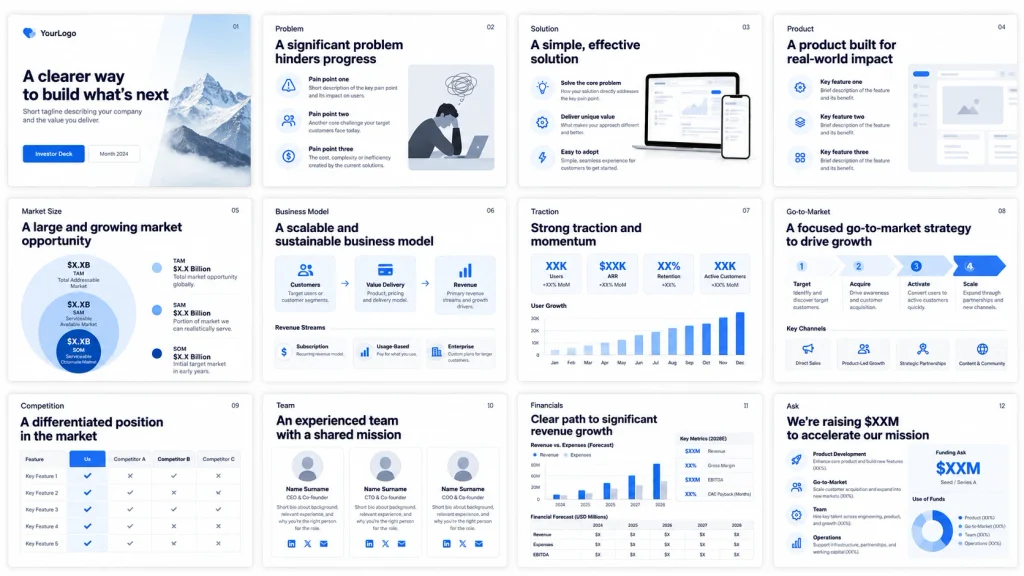
Keep your deck short and easy to follow. A practical structure: company introduction, problem, solution, product, market size, business model, traction, competition, go-to-market strategy, financial projections, founding team, funding ask, and use of funds. Save it as a PDF so it opens on any phone.
Do not exaggerate your market size. Avoid claims like “We are entering a $10 billion market.” Show how you calculated your:
- TAM: the total market.
- SAM: the part you can realistically serve.
- SOM: the part you can win in the near term.
Cite the source or method behind each number.
Done when: someone outside your team understands your business after reading the deck once.
Step 3: Identify the Right Investors
Do not contact every investor you find. Build a shortlist of 15 to 20 and track them in a simple sheet. For each investor, check:
- Do they invest at your stage and in your sector?
- Do they invest in Pakistan or comparable markets?
- Does their cheque size match your raise?
- Do they make follow-on investments?
- Have they already backed a direct competitor?
- Does their investment thesis match your business?
Example: suppose you are building a pre-seed fintech startup and need $300,000. i2i Ventures may fit better than a fund that only writes multi-million-dollar Series A cheques, because it focuses on pre-seed and seed with initial cheques typically between $250,000 and $500,000. Indus Valley Capital is another Pakistan-focused fund worth researching. That is what investor fit looks like.
Done when: you have a shortlist with each investor’s stage, cheque size, and a reason why they fit.
Step 4: Look for Warm Introductions
A warm introduction usually gets more attention than a cold message. Good sources include portfolio founders, incubator mentors, accelerators, industry experts, university networks, founder communities, and startup events.
A practical method:
- Choose an investor from your shortlist.
- Review their portfolio.
- Find a founder they have backed.
- Build a genuine relationship with that founder first.
- Ask for an introduction only if your startup is relevant, and send a short blurb they can forward.
Do not ask random people to “connect you to investors.” Research first.
Done when: you have asked for introductions to your top 5 investors.
Step 5: Use Personalized Cold Outreach
If you cannot get a warm introduction, send a short, personalized email or LinkedIn message. Include:
- who you are
- what the startup does
- one strong traction metric
- how much you are raising
- why you chose this investor
- a link to your deck
- a simple meeting request
Sample template (fictional, for illustration only; replace all details with your own):
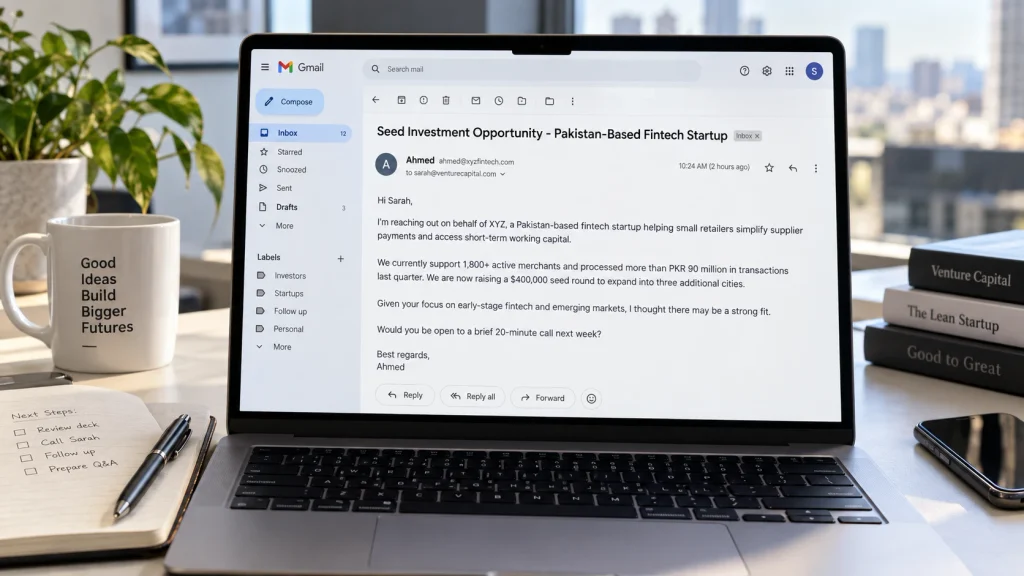
Subject: Seed Investment Opportunity — Pakistan-Based Fintech Startup
Hi Sarah,
I’m reaching out on behalf of XYZ, a Pakistan-based fintech startup helping small retailers simplify supplier payments and access short-term working capital.
We currently support 1,800+ active merchants and processed more than PKR 90 million in transactions last quarter. Based on this traction, we’re now raising a $400,000 seed round to strengthen the product, expand our team, and launch in three additional cities.
We came across your fund while researching investors focused on early-stage fintech and emerging markets, and we believe there could be a strong fit with your investment focus.
I’d be happy to share our pitch deck and additional traction metrics. Would you be available for a brief 20-minute introductory call next week to explore whether there may be an investment fit?
Best regards,
YOUR NAME
[Job Title / Founder & CEO]
XYZ
[Company Website]
[LinkedIn]
[Email] | [Phone]
The key is relevance. Do not send the same message to 100 investors. If you get no reply, follow up once after about a week.
Done when: you have sent personalized messages to your shortlist and tracked every reply.
Step 6: Prepare for the First Investor Meeting
The first meeting is not about closing the deal. It is about convincing the investor that your business deserves deeper evaluation. Be ready to answer:
- What problem are you solving, and why does it matter?
- Why will customers pay, and how do you make money?
- What traction do you have, and what are your growth rate and retention?
- What makes you different from competitors?
- How much are you raising, and where will the money go?
- What milestones will you reach in the next 12 to 18 months?
Interview the investor too. Ask about their typical cheque size, whether they invest again in later rounds, how long their process takes, whether they require a board seat, how involved they are after investing, any portfolio conflicts, and how they help companies raise the next round. Fundraising is a two-way decision.
After the meeting, send a thank-you email within 24 hours with a summary and any documents they asked for.
Done when: the investor asks for more information or a second meeting.
Step 7: Prepare for Due Diligence
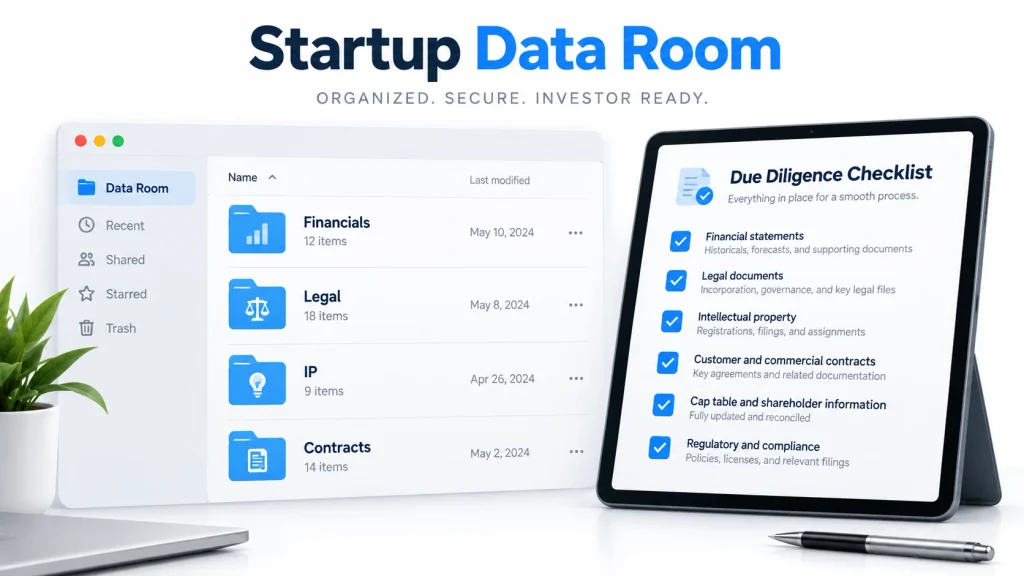
If an investor becomes seriously interested, they will review your company in detail. Set up a data room (a shared, organized folder) before you need it. It should contain:
- incorporation documents
- cap table
- shareholder agreements
- financial statements
- bank records
- tax documentation
- contracts
- customer data
- employee agreements
- IP ownership documents
- product metrics
- major commercial agreements
Government-backed programs like the Pakistan Startup Fund also run legal, financial, operational, and technical due diligence before approving a grant. Disorganized documents can slow down or kill a deal.
Done when: every document above is in one organized folder, and your cap table is accurate.
Step 8: Review the Term Sheet Carefully
A term sheet summarizes the main terms of the deal. It is usually non-binding, but it shapes the final legal agreements, so read it carefully. The terms that matter most:
- Valuation: what the investor says your company is worth before investing.
- Dilution: how much your ownership percentage drops when new shares are issued.
- Liquidation preference: who gets paid first, and how much, if the company is sold.
- Board seats and voting rights: how much control the investor gets over decisions.
- Founder vesting: you earn your shares over time instead of owning them all on day one.
- Pro-rata rights: the investor’s right to invest in future rounds to keep their percentage.
- Anti-dilution clauses: protection for the investor if you later raise at a lower valuation.
Always use a qualified legal and tax adviser before signing. Do not choose an investor only because they offer the highest valuation. Terms, reputation, future support, and alignment matter just as much.
Done when: a lawyer has reviewed the term sheet, and you understand every term you are agreeing to.
Step 9: Close the Round and Apply for the Pakistan Startup Fund
Once your private investor has committed, or you are in the advanced stages of closing, complete the legal documents and receive the investment. If you are eligible, you can apply to the Pakistan Startup Fund while the round is closing. Eligibility and grant details are explained in the Funding Options section above. You can apply through the Ignite website.
Done when: the funds are in your company account, and your use-of-funds plan is running.
Where Can You Find Startup Investors and Funding Opportunities in Pakistan?
Venture Capital Investors
i2i Ventures invests in pre-seed and seed-stage startups and is sector-agnostic, with a focus on companies addressing large market opportunities in Pakistan. Its typical initial cheque size ranges from $250,000 to $500,000.
Best suited for: Early-stage, scalable startups with strong founder quality and market potential.
Official website: i2i Ventures
Indus Valley Capital
Indus Valley Capital backs Pakistani founders across multiple sectors and says it often invests early. Its portfolio includes companies in e-commerce, fintech, logistics, AI, agritech, SaaS, healthtech, edtech, and other technology categories.
Best suited for: Technology startups targeting large markets and capable of scaling.
Before approaching: Review its portfolio to understand sector fit and check for potential competitor overlap.
Official website: Indus Valley Capital
Portfolio: Indus Valley Capital Portfolio
Government Funding and Startup Support Programs
Pakistan Startup Fund — Ignite
A government-backed grant program run by Ignite under the Ministry of IT & Telecom. It is not a traditional VC investor and works best for startups already raising private investment. Grant details are explained in the Funding Options section above.
Official website and application details: Pakistan Startup Fund — Ignite
NICAT — National Incubation Center for Aerospace Technologies
NICAT is a specialized incubator for founders working in areas such as aerospace, deep tech, AI, robotics, IoT, advanced hardware, cybersecurity, and autonomous systems. Its incubation program runs for 12 months and currently takes 0% equity.
NICAT provides structured incubation, mentorship, technical and R&D access, industry connections, market access, and capital-access opportunities through investor-readiness initiatives and investor events.
Best suited for: Deep-tech and technology-driven startups that need technical support, industry access, and investor connections.
Official website: NICAT
Incubation program: NICAT Incubation Programme
Founder Networks, Demo Days, and Startup Events
Investors are not found only through websites. Many founder-investor relationships begin through warm introductions, incubator networks, demo days, startup competitions, university entrepreneurship programs, industry conferences, and founder communities.
Instead of attending events randomly, use a simple process:
- Review the speakers, judges, sponsors, and investor attendees before the event.
- Identify investors whose stage and sector match your startup.
- Research their portfolio before approaching them.
- Prepare a short 20–30 second founder introduction.
- Try to arrange meetings before the event where possible.
- Follow up within 24–48 hours after meeting someone.
- Mention where you met and include one strong traction metric in your follow-up.
Quick Comparison
| Option | Type | Typical Fit | What You Can Get |
| i2i Ventures | VC investor | Pre-seed / Seed | Equity investment |
| Indus Valley Capital | VC investor | Early-stage technology startups | Equity investment |
| Pakistan Startup Fund | Government-backed program | Startups already raising private capital | Non-equity grant |
| NICAT | Incubator | Aerospace / Deep tech / Emerging tech | Incubation, mentorship, technical support, investor access |
| Founder networks & demo days | Networking channel | Most early-stage founders | Warm introductions and investor relationships |
What Do Investors Look for Before Investing?
A strong founding team: Investors look for founders who understand the customer deeply, can execute, learn from feedback, recruit capable people, and communicate risks honestly. Relevant industry experience, complementary co-founders, and evidence of execution can strengthen the case.
A clear market opportunity: Be specific about who your customer is, how large the realistic market is, and why the problem is important enough for customers to pay to solve it. Avoid vague claims such as “everyone is our customer.”
Real traction: Show measurable evidence such as paying customers, monthly recurring revenue, user growth, retention, transaction volume, repeat purchases, signed pilots, or letters of intent. Exact numbers are more convincing than statements like “we are growing quickly.”
A sustainable business model: Explain who pays, how much they pay, your gross margin, customer acquisition cost, retention, revenue model, and how the business can become financially sustainable over time.
Capital efficiency: Investors also want to understand what you can achieve with the capital you raise. A clear plan that links spending to measurable milestones is usually stronger than simply asking for a large round.
Common Mistakes Pakistani Founders Make
Note: Figures below are only examples. Replace them with your startup’s real metrics.
- Pitching the wrong investor: If a fund backs seed-stage startups and you’re raising Series A, the fit is weak. Match stage, sector, and cheque size.
- Sending generic outreach: Personalize every message. Explain why that specific investor fits your startup.
- Using unsupported market numbers: Avoid vague claims like “$10B market.” Use credible sources and show how you calculated TAM, SAM, SOM.
- Showing weak traction: Replace “we’re growing fast” with real numbers, MRR grew from PKR 1.8M to PKR 3.1M in six months.
- Having no clear use of funds: Say exactly what the money will do. Example: raise $500,000 to hire six engineers, expand to Lahore and Islamabad, and hit specific revenue milestones in 18 months.
- Raising too early: An idea alone is hard to fund. Validate the problem, build an MVP, or get early users first.
- Not researching investors: Check their portfolio, stage, sector, reputation, founder references, and conflicts before approaching.
- Ignoring suspicious offers: Avoid anyone promising guaranteed investment or asking for unusual upfront processing fees.
Building Investor Relationships with ORLUMENS
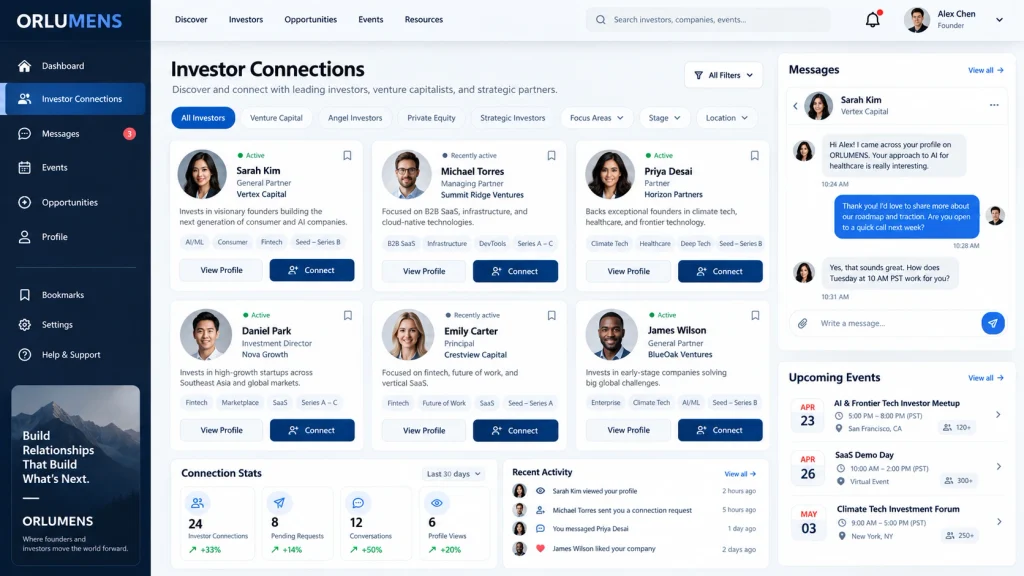
Fundraising is a relationship game. On ORLUMENS, founders, CEOs, and investors connect in one place.
Here’s what you can do on ORLUMENS:
- Discover business events
- Build warm relationships with investors
- Learn from the founder community
- Strengthen your professional network
Note: ORLUMENS does not guarantee funding. Investment decisions are made between the investor and the startup.
Join ORLUMENS and start building your network today.
Final Investor-Readiness Checklist
Business Readiness
- My startup stage is clear.
- My target customer is clearly defined.
- My business model is clear.
- My traction metrics are accurate.
- My customer and revenue evidence is organized.
- My financial model is updated.
Fundraising Readiness
- My funding requirement is clear.
- My use of funds is documented.
- My pitch deck is ready.
- I know what milestones this funding should help us achieve.
- My funding ask is realistic for my stage and traction.
Investor Outreach
- I have researched investors by stage, sector, geography, and approximate cheque size.
- I have checked whether they have invested in direct competitors.
- I have identified possible warm introductions.
- My cold outreach is personalized.
- I can explain in one or two sentences why each investor may be a good fit.
Due Diligence and Legal Readiness
- My data room is organized.
- My cap table is accurate and up to date.
- My incorporation documents are available.
- My tax and financial records are organized.
- My major customer, supplier, and employee agreements are available.
- My intellectual property ownership is documented where relevant.
- I am prepared for investor due diligence.
- A qualified lawyer will review any term sheet and final investment documents before signing.
Frequently Asked Questions
How can I get startup funding in Pakistan?
To get startup funding in Pakistan, first make your startup investor-ready by validating your idea, building a working product or MVP, organizing your traction and financial metrics, and preparing a clear pitch deck. Then shortlist investors that match your startup’s stage, sector, and funding needs, and approach them through warm introductions or personalized outreach. You can also explore government-backed programs such as the Pakistan Startup Fund, as well as relevant incubators and accelerators. If an investor shows interest, be prepared for due diligence and have a qualified lawyer review the term sheet before signing.
How do I find investors for my startup in Pakistan?
Make your startup investor-ready, then shortlist investors by sector, stage, and cheque size. Use portfolio founders, incubators, accelerators, events, and founder communities for warm introductions. If you can’t get one, use personalized cold outreach with clear traction, a funding ask, and a concise deck.
Where can I find angel investors in Pakistan?
Through founder networks, incubators, accelerators, business communities, demo days, industry events, and introductions from other founders. Don’t collect as many names as possible; focus on investors who understand your industry and stage.
Do I need revenue before approaching investors?
Not always. Pre-revenue startups can raise funding, but they usually need other strong validation: a working product, user growth, pilot customers, letters of intent, or exceptional founder-market fit. Revenue or customer validation generally strengthens your case.
What should a startup pitch deck include?
Problem, solution, product, market size, business model, traction, competition, go-to-market strategy, financial projections, founding team, funding ask, and use of funds.
How much funding can a Pakistani startup raise?
There is no fixed amount. It depends on your stage, traction, industry, valuation, investor interest, and target milestones. A better question: How much capital do we need to reach the next meaningful milestone?
How long does fundraising take?
There is no guaranteed timeline. It depends on your stage, investor process, due diligence, round size, and documentation. Maintain enough runway, because meetings, negotiations, and legal closing take time.
The Path to Startup Funding in Pakistan
Finding investors in Pakistan becomes much easier when fundraising is treated as a structured business process rather than simply a search for money.
The most effective path is to:
Become investor-ready → identify the right investors → research their stage, sector, and portfolio → build warm relationships → send personalized outreach → run strong investor meetings → prepare for due diligence → review and negotiate the term sheet carefully.
Pakistan’s startup funding environment is selective, which means founders need to show more than a strong idea. Clear traction, a credible business model, disciplined use of capital, strong documentation, and a well-defined funding plan can significantly improve the quality of investor conversations.
Not every investor will be the right fit, and not every meeting will lead to funding. The goal is not to pitch as many investors as possible. The goal is to find investors whose stage, sector, cheque size, and long-term expectations align with your startup.
For founders, the most important next step is simple: prepare well, target carefully, and approach investors with evidence rather than assumptions. A focused fundraising process gives you a much better chance of building the right investor relationships and securing capital on terms that support the long-term growth of your company.
Disclaimer: This article is for general information only and is not legal, tax, or financial advice. Funding programs, eligibility rules, and investor details can change, so please verify current terms with the official source before applying. ORLUMENS does not guarantee funding or investor responses. Consult a qualified lawyer or adviser before signing any investment document.
By Noor ul Hassan
Founder, ORLUMENS
Last updated: October 2026
5 Responses