
By Noor Ul Hassan, CEO, ORLUMENS | Published November 21, 2026 | Updated November 21, 2026
Finding a reliable business partner in Pakistan can feel difficult when you lack industry contacts or personal introductions. Whether you are launching a startup, expanding an SME, or entering a new market, the challenge is not simply meeting people—it is identifying someone who has the right capabilities, shares your goals, and can be trusted with business responsibilities.
Fortunately, entrepreneurs can now explore professional networks, startup incubators, business directories, and industry organizations without relying on existing connections.
Quick Answer: How to Find Reliable Business Partners in Pakistan?
To find reliable business partners in Pakistan without personal connections, identify the type of partner you need, explore LinkedIn, startup incubators, chambers of commerce, and business matching platforms, then shortlist potential collaborators. Verify their legal identity, credentials, and professional references before testing a small collaboration or entering a formal partnership agreement.
This guide explains where to find business partners in Pakistan, how to approach them, how to verify their background, and which legal and Islamic partnership structures may be relevant.
What Makes a Reliable Business Partner?
A reliable business partner brings complementary skills, resources, or industry relationships while demonstrating accountability and financial transparency.
Before beginning your search, determine whether you need a co-founder, investor, distributor, supplier, or strategic collaborator.
These relationships are different.
| Partner type | Primary purpose |
|---|---|
| Co-founder | Builds and manages a business alongside you |
| Strategic partner | Provides expertise, distribution, technology, or market access |
| Investor | Provides capital under agreed investment terms |
| Supplier or distributor | Supports product sourcing or market delivery |
| Equity partner | Holds an agreed ownership interest in a business |
For example, a textile manufacturer expanding from Lahore into Karachi might need a distributor rather than a co-founder.
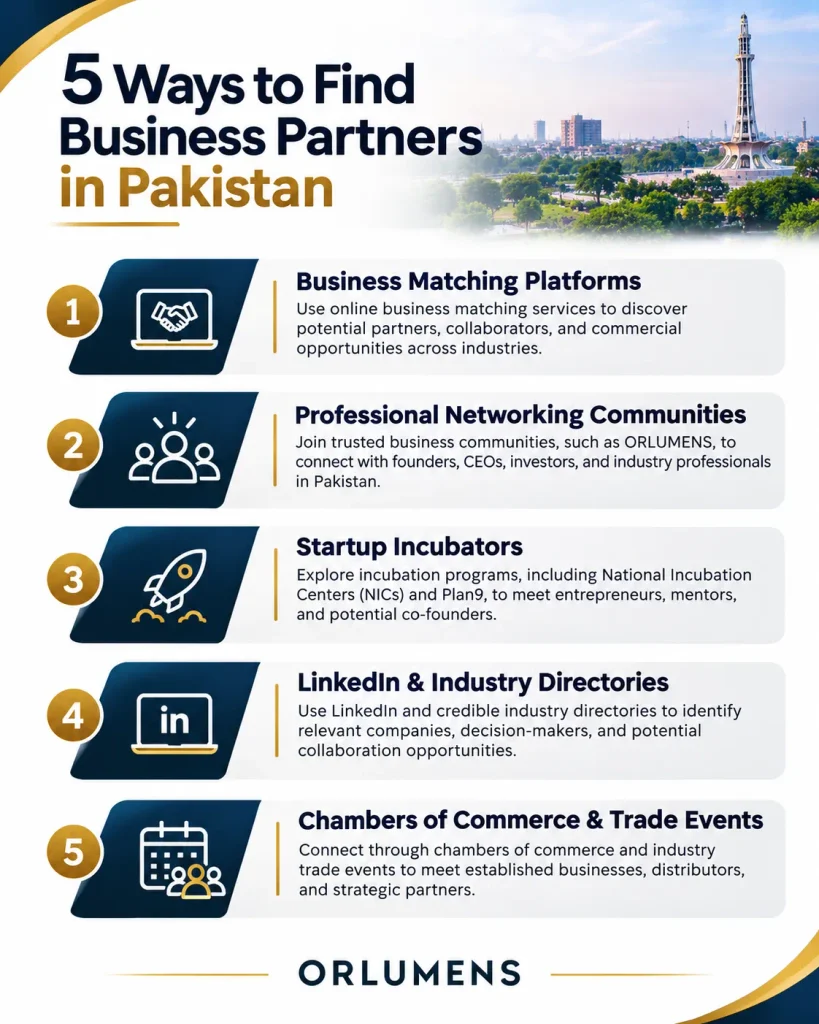
5 Ways to Find Business Partners in Pakistan Without Connections
1. Explore Business Matching Platforms
Online platforms can help entrepreneurs discover relevant businesses beyond their existing networks.
Consider researching:
- MyPakPartner. Pakistan-focused business matchmaking and commercial partner discovery.
- Foundersbase Pakistan. Startup networking and potential co-founder discovery.
- Pakistan Japan Business Forum. Business matchmaking relevant to Pakistan–Japan commercial relationships.
Select platforms according to your industry and partnership objective. Review current services, eligibility, and available information before engaging.
A profile or directory listing is not proof of credibility.
2. Join Professional Business Networking Communities
Professional communities help entrepreneurs build relationships with founders, executives, and experienced business owners.
Rather than asking for a partnership immediately, focus on relevant conversations, mutual interests, and professional credibility.
ORLUMENS (our platform) is a Pakistan-focused business networking and intelligence ecosystem for entrepreneurs, CEOs, founders, investors, and professionals.
For more guidance, explore the ORLUMENS business networking guide.
3. Explore Startup Incubators and Entrepreneurial Networks
Startup incubators can provide access to entrepreneurial communities, mentorship activities, events, and relevant industry contacts.
Pakistan’s National Incubation Center ecosystem operates across several cities, including Islamabad, Lahore, and Karachi.
Entrepreneurs can also explore Plan9, an incubation initiative associated with the Punjab Information Technology Board.
These programs are particularly relevant to startup founders seeking technical collaborators, mentors, or other entrepreneurial connections.
However, incubator admission, current programs, and access to events may depend on eligibility and availability.
For established SMEs, industry associations and trade forums may be more appropriate.
4. Use LinkedIn and Industry Directories
LinkedIn helps entrepreneurs identify potential partners by company, industry, professional role, and location.
Start by defining the required capabilities.
For example, a food manufacturer looking for a distributor could search for relevant distribution companies, shortlist candidates, and approach suitable decision-makers.
Follow this process:
- Search for relevant companies and professionals.
- Review available business information.
- Identify complementary capabilities.
- Send a personalized introduction.
- Arrange an exploratory conversation.
Industry directories can support discovery, but credentials must be independently verified.
5. Connect Through Chambers of Commerce and Trade Events
Chambers of commerce and industry associations can help businesses discover sector-specific networks and professional opportunities.
Relevant organizations include:
- Lahore Chamber of Commerce and Industry
- Karachi Chamber of Commerce and Industry
- Islamabad Chamber of Commerce and Industry
- Federation of Pakistan Chambers of Commerce and Industry
For trade-focused opportunities, explore the Trade Development Authority of Pakistan.
Check event schedules, membership requirements, and industry relevance before participating.
How to Verify a Business Partner in Pakistan: 5 Steps
Partner verification should take place before transferring substantial funds, disclosing sensitive information, or signing a long-term agreement.
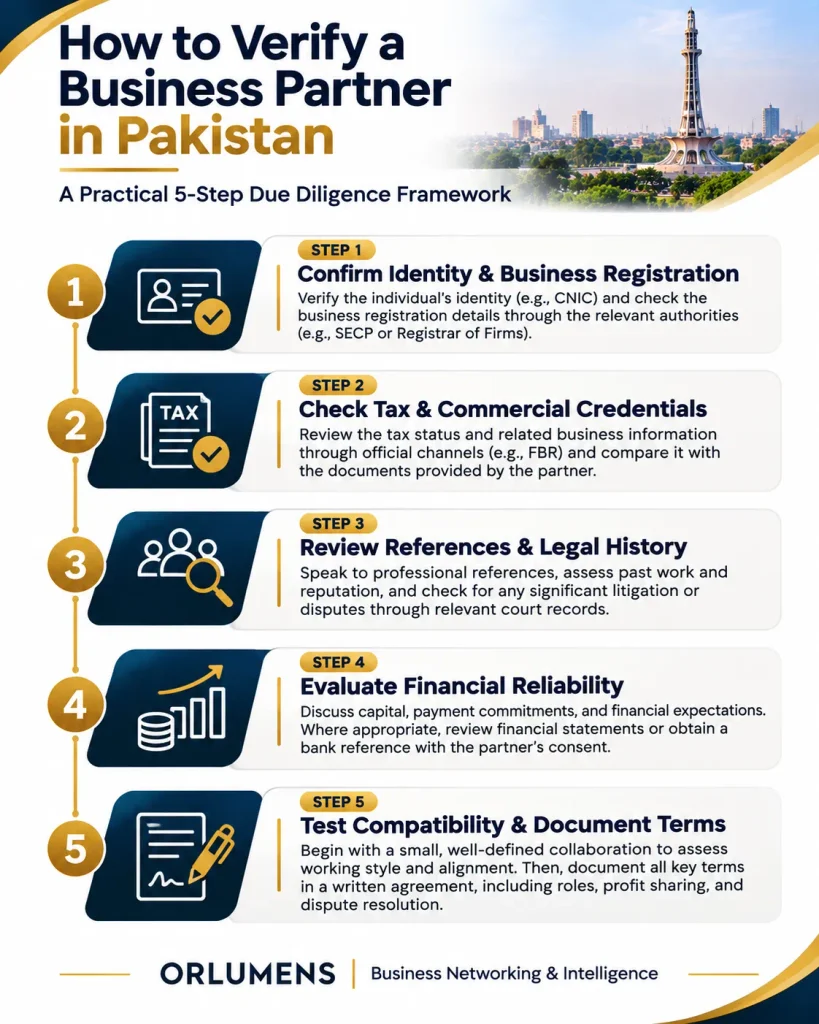
Step 1: Confirm Identity and Business Registration
Ask for the potential partner’s full legal name, business address, registration information, and proof of authority to represent the business.
Where necessary and lawful, verify the identity of individuals through appropriate identification documents, such as a CNIC, using secure handling procedures.
For an incorporated company or LLP, consult the Securities and Exchange Commission of Pakistan.
For a registered traditional partnership, contact the relevant Registrar of Firms.
Official resources include:
Other provinces administer their own registration processes.
A company name search does not prove ownership, signing authority, or financial reliability.
Step 2: Check Tax and Commercial Credentials
Use the Federal Board of Revenue verification services to review relevant taxpayer information.
Compare available records with the business documents supplied.
Also review the company’s website, business address, operating history, and relevant commercial credentials.
A valid registration or tax record is evidence of registration or status—not a guarantee of trustworthiness.
Step 3: Review References, Litigation, and Reputation
Request relevant business references and ask permission to contact them independently.
Review previous projects, experience, and delivery history.
For substantial partnerships, ask a Pakistani lawyer to conduct appropriate litigation and legal-dispute searches using available court records.
A lack of easily discoverable litigation does not establish that a person or company has never been involved in a dispute.
Step 4: Evaluate Financial Reliability
Discuss capital contributions, payment obligations, outstanding commitments, and financial expectations.
Where justified by the transaction size, obtain financial statements, credit information, or a bank reference with the prospective partner’s consent.
A bank reference does not guarantee future performance.
Watch for warning signs such as requests for payment to unrelated personal accounts, pressure to invest immediately, unverifiable financial claims, or refusal to document commercial terms.
Step 5: Test Compatibility and Sign Written Terms
Where suitable, begin with a small, clearly defined collaboration.
Agree on deliverables, timelines, responsibilities, payment terms, confidentiality, and dispute-resolution procedures.
Evaluate how the potential partner communicates and handles commitments.
Before moving to a larger arrangement, have the proposed agreement reviewed by a qualified legal professional.
Legal Partnership Structures in Pakistan
A business collaboration does not always require forming a new legal entity. However, ownership-based partnerships need careful structuring.
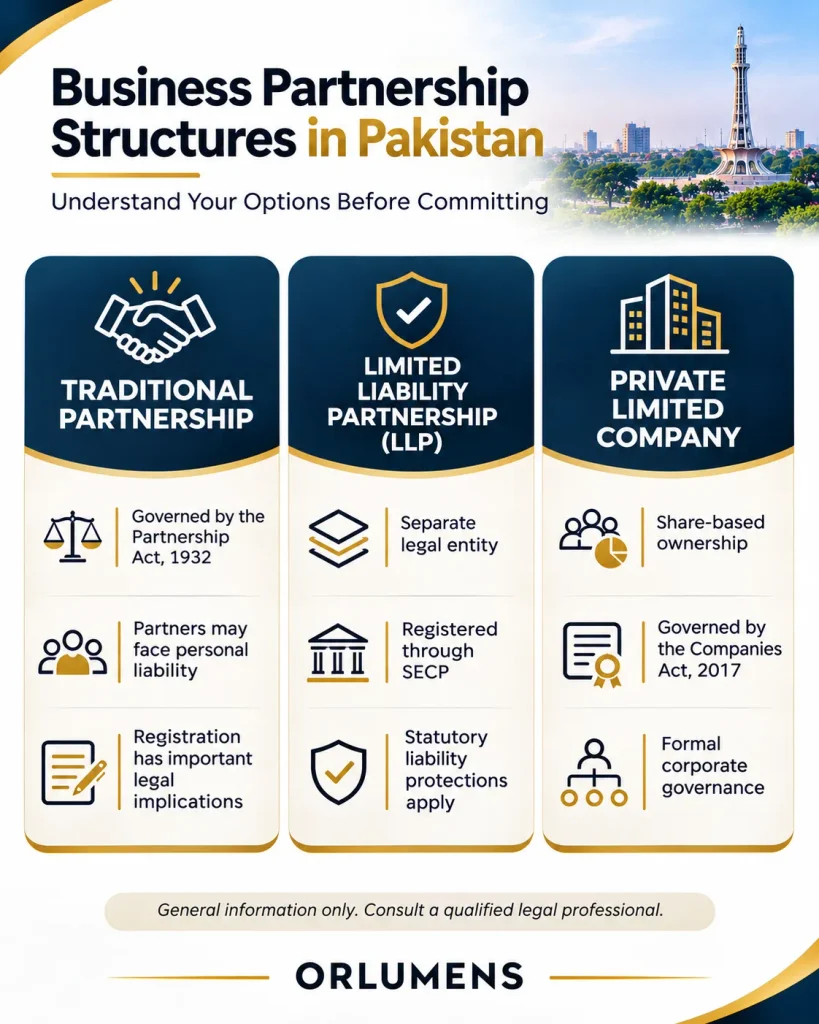
Traditional Partnership Firm
The Partnership Act, 1932 governs traditional partnerships.
A partnership can exist without firm registration, but non-registration creates important restrictions.
Section 69 generally prevents an unregistered firm from bringing certain lawsuits to enforce contractual rights against third parties, subject to the Act’s provisions and exceptions. Registration status can also affect proceedings involving partners.
This makes registration important even where it is not a condition for creating the partnership relationship.
Limited Liability Partnership (LLP)
An LLP is a separate legal entity registered under Pakistan’s Limited Liability Partnership Act, 2017.
It combines partnership-style features with statutory liability protections.
Registration and compliance are administered through the SECP framework.
Private Limited Company
A private limited company supports share-based ownership and formal corporate governance.
It may be appropriate where entrepreneurs plan to bring in equity investors or establish a business with multiple shareholders.
Choosing a structure: Obtain legal and tax advice based on the proposed ownership, capital contributions, liabilities, and operating arrangements.
Islamic Partnership Structures: Musharakah and Mudarabah
Islamic finance offers partnership models based on agreed contractual principles.
Musharakah
Musharakah involves joint participation in a business arrangement.
Under the principles described by the State Bank of Pakistan, partners agree on profit-sharing ratios in advance, while financial losses are allocated according to capital contributions.
A sleeping partner is a capital-contributing partner who does not actively participate in management.
The specific profit-sharing rules for active and sleeping partners must be considered when structuring the agreement.
Mudarabah
Mudarabah is an arrangement in which one party provides capital and the other manages the business.
The capital provider is called the Rab-ul-Maal, while the business manager is called the Mudarib.
The parties agree on a share of actual profits.
Under the standard model, financial losses are borne by the capital provider, except where the manager is responsible for misconduct, negligence, or a breach of agreed obligations.
Musharakah vs. Mudarabah
| Feature | Musharakah | Mudarabah |
|---|---|---|
| Capital | Contributed by participating capital partners | Provided by capital owner |
| Management | Partners may participate | Conducted by Mudarib |
| Profit | Agreed share of actual profits | Agreed share of actual profits |
| Financial loss | According to capital contributions | Ordinarily borne by capital provider, subject to exceptions |
Source: State Bank of Pakistan — Islamic Banking FAQs.
These models do not replace applicable business registration requirements. Consult qualified Pakistani legal and Shariah advisers before implementing an arrangement.
How to Approach a Potential Business Partner
A professional outreach message should communicate your business, a relevant collaboration opportunity, and a clear next step.
Business Partnership Email Template
Subject: Exploring a Potential Business Partnership
Hello [Name],
I came across [Company Name] while researching businesses in [industry/location].
I represent [Your Company], where we specialize in [brief description].
We are exploring potential partnerships with businesses that have complementary strengths in [specific area].
Your company’s work appears relevant to our objectives, and I would welcome an opportunity to learn more about your business.
Would you be available for a brief introductory conversation?
Best regards,
[Your Name]
[Company Name]
Avoid promising investment, exclusivity, or guaranteed commercial benefits during the first conversation.
Equity Splits, Profit Sharing, and Sleeping Partners
There is no universal equity split that suits every partnership.
A 50/50 arrangement is not automatically fair, and equal ownership does not always mean equal responsibilities.
Before agreeing on percentages, consider:
- Capital invested by each party
- Time and operational responsibilities
- Intellectual property contributions
- Existing business assets
- Commercial risks
- Decision-making authority
- Exit and buyout provisions
A sleeping partner contributes capital without actively managing the business.
The appropriate arrangement depends on the legal structure and contractual terms. For Shariah-based Musharakah, additional profit-sharing restrictions apply.
Record the agreed structure before commencing substantial business activities.
Business Partner Due-Diligence Checklist
Use this checklist before making a partnership commitment.
- Define the required partnership type.
- Verify legal identity and registration.
- Confirm the representative’s authority.
- Review applicable tax records.
- Contact relevant professional references.
- Consider litigation and dispute checks.
- Assess financial reliability.
- Agree on contributions and profit-sharing terms.
- Clarify management and decision-making.
- Review legal and Shariah requirements where relevant.
- Document confidentiality and dispute-resolution terms.
- Obtain professional review before signing.
Frequently Asked Questions
Where can I find business partners in Pakistan?
Explore LinkedIn, business matchmaking services, chambers of commerce, startup incubators, professional networking communities, and relevant industry organizations.
Can I find a business partner without personal connections?
Yes. Targeted research, professional platforms, networking events, and direct outreach allow entrepreneurs to establish business relationships without existing introductions.
How do I verify a business partner in Pakistan?
Confirm identity, review relevant registration and tax information, check references, assess financial and legal risks, and establish written commercial terms.
Is partnership firm registration compulsory in Pakistan?
No, A traditional partnership can be formed without registration under the Partnership Act, 1932. However, Section 69 restricts certain lawsuits to enforce contractual rights involving unregistered firms, subject to statutory exceptions. The rules differ for LLPs and companies, which require incorporation or registration under their respective frameworks.
What is the difference between Musharakah and Mudarabah?
Musharakah involves joint capital participation with agreed profit-sharing ratios and losses allocated by capital contribution. Mudarabah involves a capital provider and a manager, with profits shared by agreement and financial losses ordinarily borne by the capital provider, subject to applicable exceptions.
What is the safest way to start a business partnership?
Verify the prospective partner, assess compatibility, obtain professional advice, document commercial terms, and consider a limited initial collaboration before making larger commitments.
Conclusion
Finding reliable business partners in Pakistan without connections requires a structured process: identify the right type of partner, explore relevant business networks, verify credentials, and establish clear commercial expectations.
Professional relationships become valuable when they are supported by trust, accountability, and complementary capabilities.
Noor Ul Hassan is the CEO of ORLUMENS, a Pakistan-focused business networking and intelligence platform for founders, executives, and investors.
Disclosure: ORLUMENS is the publisher of this article.
Official Sources
- Partnership Act, 1932 — Sindh Judicial Academy
- SECP — Limited Liability Partnerships
- Punjab — Firm Registration
- ICT Administration — Firm Registration (Islamabad)
- FBR — IRIS
- State Bank of Pakistan — Islamic Banking FAQs
Sources last reviewed: November, 2026.
Disclaimer: This article provides general educational information and does not constitute legal, tax, investment, or Shariah advice. Consult qualified professionals before entering significant commercial arrangements.