
Published: November 7, 2026 | Last updated: November 7, 2026
To respond to investor rejection, thank the investor, accept the decision without arguing, ask one low-pressure feedback question only if appropriate, and offer future updates when you have real progress.
An investor saying “no” does not always mean your startup is fundamentally weak. The decision may reflect timing, traction, investment thesis, geography, stage, portfolio priorities, or simply the investor’s current conviction.
For Pakistani founders, handling rejection professionally matters because the same investor may become relevant in a future round, make an introduction, or reconsider after your company reaches a stronger milestone.

Quick Answer: How Should You Respond to Investor Rejection?
When an investor rejects your startup:
- Understand the type of rejection: “Not now,” “not enough traction,” and “not a fit” need different replies.
- Thank them for their time: Keep it professional and brief.
- Do not argue with the decision: Trying to reverse a “no” right away rarely helps.
- Ask for feedback when appropriate: One specific, low-pressure question is enough.
- Ask whether future updates are welcome: Do this if there is a realistic way back.
- Reconnect only when something meaningful changes: New revenue, customers, retention, partnerships, or product progress gives you a real reason to return.
The goal is not to reverse every rejection. It is to preserve the relationship and understand what should happen next.
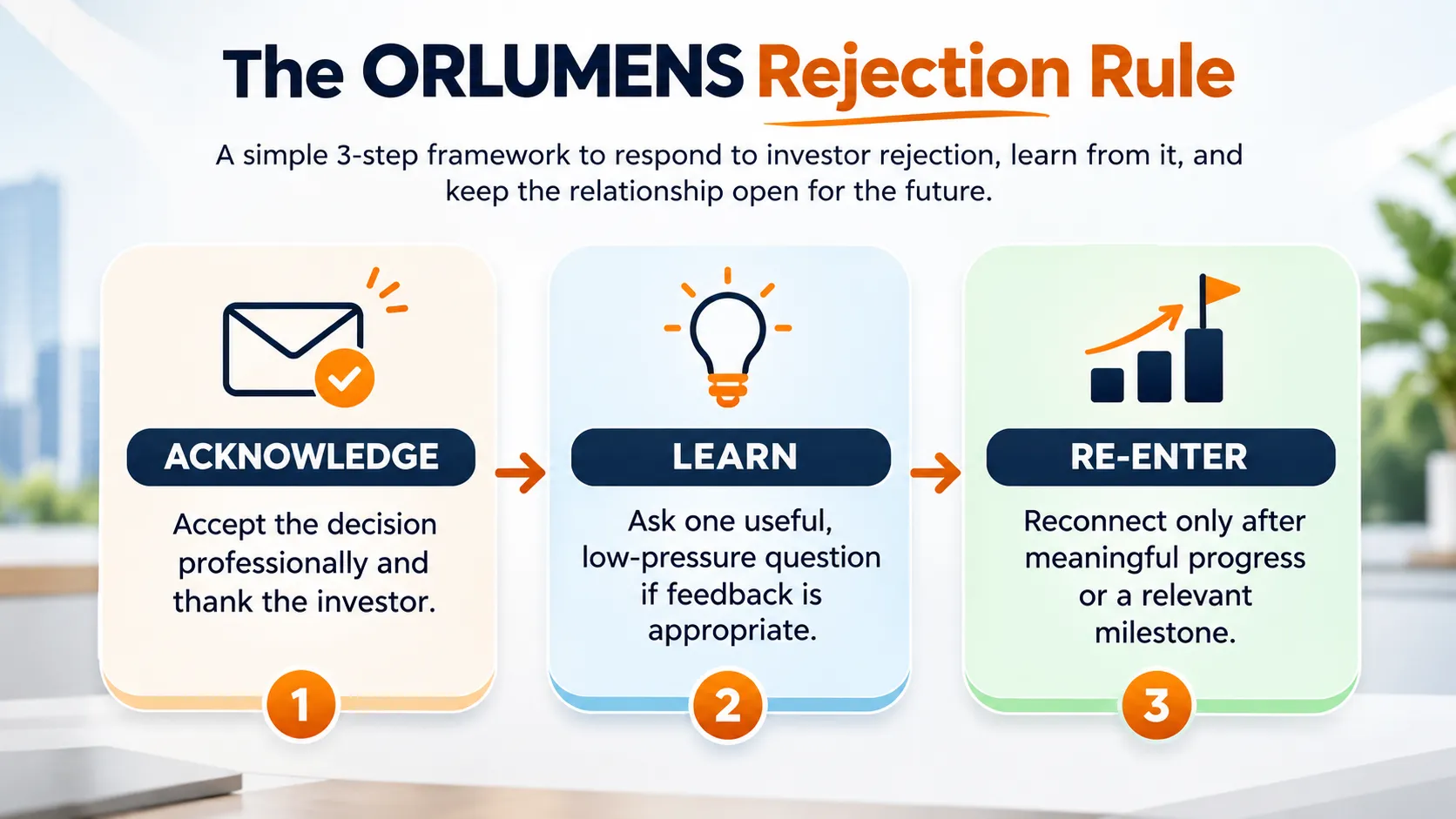
The ORLUMENS Rejection Rule: Acknowledge → Learn → Re-enter
A useful way to handle investor rejection is the ORLUMENS Rejection Rule: Acknowledge → Learn → Re-enter.
1. Acknowledge
Accept the investor’s decision professionally.
Thank them for their time and avoid becoming defensive, emotional, or argumentative.
2. Learn
If the conversation was substantive, ask whether there is one concern or milestone that would be useful for you to understand.
Not every investor will provide feedback, and you should not pressure them to do so.
3. Re-enter
Reconnect only when there is a meaningful reason.
That could be stronger traction, a major customer, improved economics, a product milestone, or another development that directly addresses the investor’s earlier concern.
The rule is simple:
Do not chase the rejection. Create a better reason for the next conversation.
Why Do Investors Reject Startups?
Investors can pass on companies for many reasons, and not all of them are direct judgments about whether the company will eventually succeed.
Common reasons include:
Stage mismatch
The startup may simply be too early or too late for the investor’s preferred stage.
A fund focused on Series A investments may pass on a pre-seed company even if the founders and market are interesting.
Investment thesis mismatch
The investor may not invest in your sector, business model, geography, or type of company.
A rejection based on fit should not automatically be interpreted as a rejection of the quality of the business.
Insufficient traction
An investor may like the idea but want stronger evidence that customers want the product.
That evidence could include revenue, active users, retention, repeat purchases, pilots, signed customers, or another metric relevant to your business.
Market or team concerns
The investor may have questions about market size, growth potential, competitive positioning, founder experience, technical capability, or important hiring gaps.
Timing or portfolio constraints
The investor may already have exposure to a similar company, may not be ready to invest in the category, or may have other portfolio considerations.
The important point is that rejection is information, but it is not always a final verdict on the company.
What Should You Say After an Investor Rejects You?
The best response is usually short.
A professional investor rejection reply should:
- Thank the investor.
- Acknowledge the decision.
- Ask one useful question if appropriate.
- Leave the relationship open.
Avoid writing a long email defending your company point by point.
Template 1: Professional Investor Rejection Reply
Subject: Thank you — [Company Name]
Hi [Investor Name],
Thank you for letting me know, and I appreciate the time you spent learning about [Company].
I understand the decision. If you are open to sharing it, I would value any brief feedback on the main concern or milestone you would want to see change.
Either way, thank you again for the conversation. I’d be happy to keep you updated if we make meaningful progress that could make the company more relevant in the future.
Best,
[Founder Name]
If the investor passed without a real conversation, delete the feedback sentence. They may not know your company well enough to give useful advice.
Should You Ask an Investor for Feedback After Rejection?
Yes, when the investor spent meaningful time evaluating the company, and you can ask without demanding an explanation.
A good feedback request is short and specific.
For example:
“If you’re open to sharing it, was there one main concern or milestone that drove the decision?”
That is better than:
“Why did you reject us?”
Be especially careful about asking for feedback when the investor gave you a quick pass before a substantive conversation. They may simply not have enough context to give useful advice.
Also remember that investor feedback is an input—not an instruction.
If one investor dislikes your pricing model and another believes pricing is one of your strengths, blindly reacting to each opinion can create confusion.
Look for patterns across multiple conversations.
If several credible investors independently raise the same concern, that signal may deserve more attention.
“Not Now” vs “Not a Fit”: What’s the Difference?
Not every rejection means the same thing.
| Investor response | What it may indicate | Best founder response |
|---|---|---|
| “Not now” | Timing, stage, or insufficient progress | Ask what milestone would make a future conversation useful |
| “Come back with more traction” | Investor wants stronger evidence | Clarify the metric or milestone if possible |
| “Not a fit for our fund” | Thesis, sector, stage, geography, or mandate mismatch | Thank them. If the relationship is warm, ask for an introduction to a better-fit investor |
| “Too early for us” | Company may become relevant later | Ask whether a future update is welcome |
| Clear no with no future condition | Low current investor interest | Close the loop and focus elsewhere |
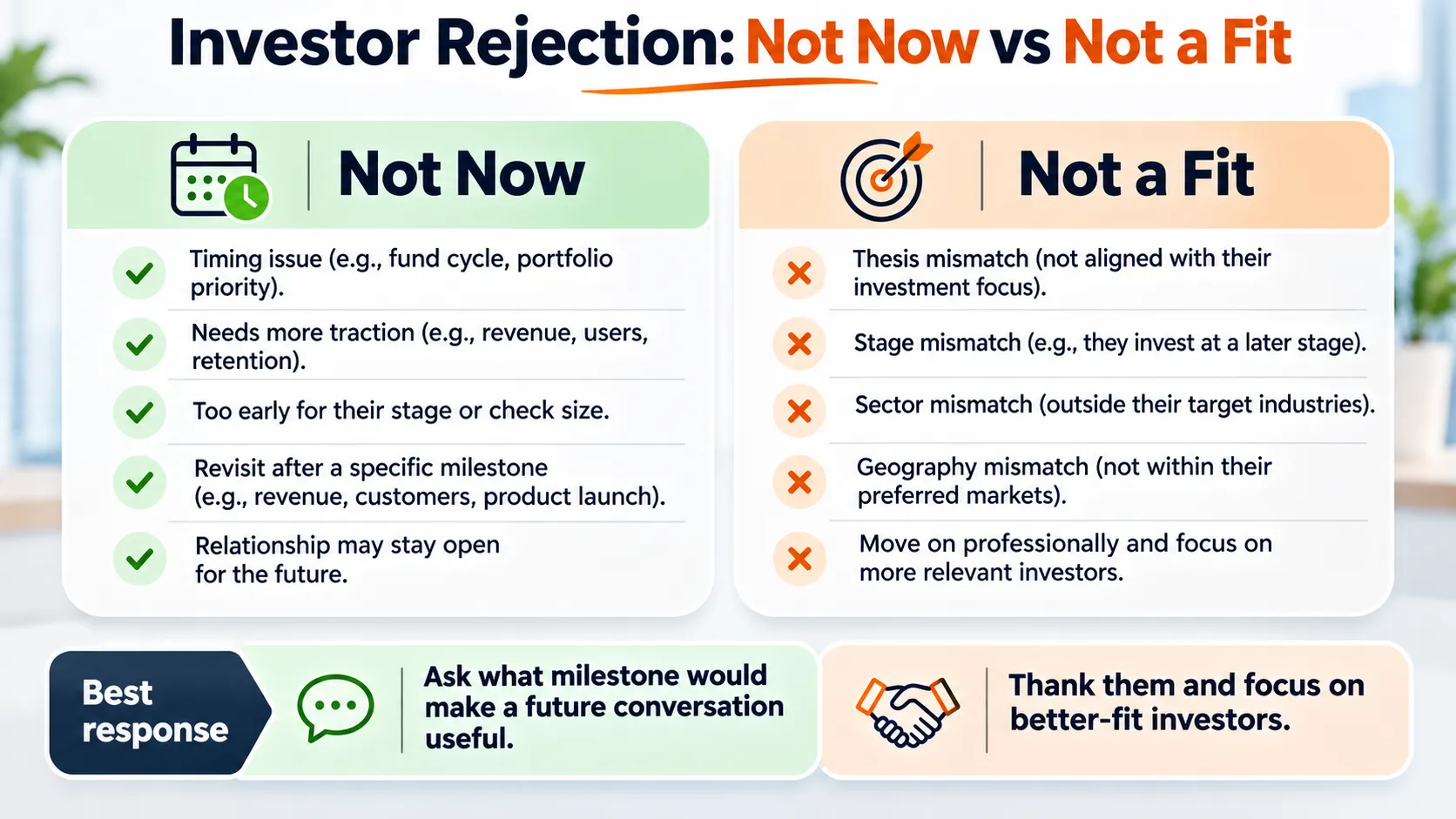
Treat these responses as signals rather than guarantees.
An investor who says “come back later” has not committed to investing later.
Your job is to understand whether there is a credible reason to reconnect, not to keep the investor permanently in an active fundraising conversation.
How to Respond to “Not Now”
A “not now” can be more useful than a vague rejection because it may reveal what would need to change.
Ask one clear question:
“Is there a particular milestone that would make it useful to reconnect?”
The answer might involve:
- reaching a revenue level
- signing several enterprise customers
- proving retention
- completing a product launch
- expanding into a relevant market
- building out the leadership team
If the investor gives you a specific condition, record it in your fundraising tracker (see Stripe’s guide to tracking your fundraising pipeline).
Template 2: “Not Now” Response
Subject: Thank you — [Company Name]
Hi [Investor Name],
Thank you for the candid feedback.
I understand that the timing is not right today. If there is a specific milestone you would want to see before revisiting the conversation, I’d appreciate knowing what would be most relevant.
Otherwise, I’ll keep the focus on execution and would be happy to reconnect if we make meaningful progress.
Thanks again,
[Founder Name]
If the investor remains interested but goes quiet later, keep your follow-up brief, relevant, and tied to meaningful progress.
How to Respond to a Clear “No”
A clear “no” should normally be treated as a closed active conversation.
Do not immediately send another pitch explaining why the investor misunderstood your company.
Instead:
- thank them
- acknowledge the decision
- keep the tone positive
- move on to other investors
Template 3: Clear Investor Rejection Response
Subject: Thank you
Hi [Investor Name],
Thank you for letting me know and for taking the time to learn about [Company].
I appreciate the conversation and understand that it is not the right fit at this stage.
If you know an investor for whom the company may be a stronger fit, I’d appreciate an introduction if you feel comfortable making one.
Thanks again for your time, and I hope we can stay in touch.
Best,
[Founder Name]
If the relationship is warm and the rejection is clearly about fit, a polite referral request can be appropriate. Do not make an introduction request feel expected or obligatory.
How to Reply If the Investor Rejects You on WhatsApp or a Call
If an investor communicates the rejection through WhatsApp or a phone call, it is usually reasonable to respond through the same channel unless they have indicated otherwise.
Keep the response short, polite, and professional.
Template 4: WhatsApp Reply
Thank you for letting me know, [Investor Name]. I appreciate your time. If you know an investor who might be a better fit and feel comfortable making an introduction, I’d be grateful. I’ll be happy to reconnect if we reach a meaningful milestone relevant to our earlier conversation.
Avoid turning a short WhatsApp exchange into another full pitch.
How to Reconnect With an Investor After Rejection
Reconnect only when you have a real result that answers the investor’s earlier concern.
Keep the message short, specific, and easy to respond to—or ignore.
Template 5: Milestone Update to a Previous Investor
Subject: Update since we last spoke — [Company Name]
Hi [Investor Name],
When we spoke in [month], you mentioned [specific concern, such as retention or customer traction].
Since then, [one concrete result, such as “our monthly retention improved from X% to Y%” or “we signed [customer name or type]”].
If it’s useful, I’d be glad to share a short update. No pressure either way, and thank you again for your time earlier.
Best,
[Founder Name]
The strongest re-entry message connects new evidence directly to something the investor previously cared about.
When Should You Contact a Rejected Investor Again?
Reconnect when you have meaningful new information—not simply because enough time has passed.
A calendar date alone is not usually a strong reason to reopen the conversation.
A better reason is a development that changes the investor’s previous assessment.
Examples include:
- meaningful revenue growth
- a major customer win
- stronger retention
- a successful product launch
- expansion into a relevant market
- an important partnership
- a key executive or technical hire
- improved unit economics
- progress toward a milestone the investor specifically requested
If the investor explicitly told you to return after a certain milestone, that instruction should take priority.
What Updates Are Worth Sending to a Rejected Investor?
A useful investor update contains information that materially changes the story.
Good examples:
- “Monthly recurring revenue increased from [X] to [Y].”
- “We signed [major customer or customer type].”
- “Retention improved from [X] to [Y].”
- “We launched in [market] and reached [relevant traction].”
- “We completed the product milestone we discussed.”
- “We hired [relevant role] to address the team gap we discussed.”
Weak updates include:
- “Just checking in.”
- “We are still working hard.”
- “Wanted to see if you changed your mind.”
- minor product changes with no clear business impact
- repeatedly sending the same pitch
The update should give the investor a new reason to reconsider, not simply remind them that you still want funding.
How Often Should You Update an Investor After Rejection?
There is no universal update schedule for every rejected investor.
If the investor has clearly invited future updates, a brief update every few months can be reasonable when you have meaningful progress to share.
If they have not invited updates, use more judgment. You do not need to send every rejected investor a monthly newsletter.
Prioritize investors who:
- engaged seriously with the company
- indicated possible future interest
- asked you to return after a milestone
- remain a strong match for a later round
- gave useful feedback that you subsequently addressed
The relationship should stay relevant, not become another automated mailing list.
Common Mistakes After Investor Rejection
Avoid these common mistakes:
- Arguing with the decision: Trying to prove the investor wrong immediately after rejection can damage the relationship.
- Sending a long defensive email: You do not need to answer every objection unless the investor invites further discussion.
- Asking for excessive feedback: One short question is enough. Do not turn the investor into an unpaid consultant.
- Repeatedly asking for another meeting: If nothing meaningful has changed, another meeting is unlikely to produce a different result.
- Treating every “no” as personal: Investment decisions can reflect fund strategy, portfolio construction, stage, geography, timing, or risk tolerance.
- Ignoring repeated feedback: If several investors independently identify the same weakness, investigate it.
- Contacting multiple partners at the same fund: If the fund has already evaluated the company, trying to bypass the decision through several partners can create unnecessary friction.
Investor Rejection for Pakistani Founders: What to Keep in Mind
Before you treat a “no” as a verdict on your startup, check whether the investor was a good fit in the first place.
For Pakistani founders raising institutional or cross-border capital, fit can depend on several things:
- Geography: Some funds invest only in certain countries or regions.
- Fund mandate: The sector, stage, and cheque size need to match.
- Company structure: Some investors may have preferences or requirements around legal structure or incorporation.
- Currency and cross-border considerations: These can influence how an overseas investor evaluates an opportunity.
- Follow-on plans: An investor may also consider whether the company is likely to access future rounds of capital.
This is why you should separate two ideas:
“This business is not compelling.”
and
“This opportunity does not fit this particular investor.”
They are not the same conclusion.
When an investor remains a strong future fit, preserve the relationship professionally. A useful milestone update later can be more effective than trying to overturn a rejection immediately.
Finally, do not wait for one investor to change their mind. Keep building a pipeline of investors who match your stage, sector, geography, and market.
For a wider fundraising plan, read How to Find Investors & Get Startup Funding in Pakistan.
FAQs
How should I respond to an investor rejection email?
Thank the investor for their time, acknowledge the decision without arguing, and keep your reply brief. If the investor spent meaningful time evaluating your startup, you can ask one low-pressure question about the main concern or milestone they would want to see change.
Should I ask for feedback after investor rejection?
Yes, when the investor has enough context to provide useful feedback. Ask one concise question rather than requesting a detailed explanation. If they do not respond, do not continue chasing them for feedback.
Can I contact an investor again after they reject my startup?
Yes, if the investor indicated future interest or you later have a meaningful development that changes the investment case. Reconnect with new traction, customers, revenue, product progress, or another relevant milestone rather than simply asking whether they have reconsidered.
What does “not now” mean from an investor?
“Not now” may indicate that the investor wants to see more traction, a later stage, stronger metrics, or another development before reconsidering. Ask politely whether there is a specific milestone that would make a future conversation useful, but do not treat “not now” as a commitment to invest later.
Should I keep rejected investors updated?
Keep investors updated when they have expressed interest in future progress or remain a strong fit for a later round. Updates should be brief and milestone-driven rather than frequent generic messages.
How can I respond to investor rejection without sounding defensive?
Thank the investor, accept the decision without arguing, and keep your reply short. If it makes sense, ask one polite question about their main concern, and offer to send an update when you reach a real milestone.
Conclusion
Knowing how to respond to investor rejection professionally can help founders preserve relationships, learn from useful feedback, and create opportunities to reconnect after meaningful progress.
Use the ORLUMENS Rejection Rule: Acknowledge → Learn → Re-enter.
Acknowledge the decision without arguing. Learn from useful feedback without treating every investor opinion as fact. Re-enter the conversation only when something meaningful has changed.
For Pakistani founders, investor rejection should not become the center of the fundraising process. Record what you learned, maintain relationships that remain relevant, and continue building a wider pipeline of investors who match your company’s stage, market, and ambitions.
Raising money is about relationships as much as pitches. ORLUMENS helps founders in Pakistan build the networks that growth depends on. Follow ORLUMENS on LinkedIn for more practical founder and investor guides.
Further Reading
- How to Reach Out to Investors for Your Startup: Cold Emails, Warm Intros, and Follow-Ups — Stripe
- How to Track and Manage Your Startup Fundraising Pipeline — Stripe
- How Startup Fundraising Works — Y Combinator
- Fundraising Advice From the Female Founders Conference — Y Combinator
About the Author
Noor ul Hassan
Noor ul Hassan writes for ORLUMENS, Pakistan’s networking and business intelligence ecosystem for founders, CEOs, investors, and business leaders. He writes about business networking, founder stories, startup funding, and investor access, with a focus on helping founders in Pakistan build the relationships that growth depends on.
His ORLUMENS guides include How to Find Investors & Get Startup Funding in Pakistan.
Here is the author’s LinkedIn Profile.