
Published: November 6, 2026 | Last updated: November 6, 2026 | Author: Noor ul Hassan
A warm intro to investors without a network means getting referred by someone the investor already knows or trusts. Even if you have no direct connection to the investor, you can build a path by becoming introducible, getting one degree closer through credible connectors, and making the introduction effortless with a short, forwardable request.
This guide by ORLUMENS explains how startup founders without an existing investor network can build credibility, find trusted connectors, and secure a warm introduction to relevant investors.
It is written for founders outside the main venture hubs, including founders in Pakistan, who are told to “just get a warm intro” but have no obvious way to get one. You will get the ORLUMENS Intro Ladder (a three-step method), a filled-in example, and copy-paste templates you can use today.
At a Glance:
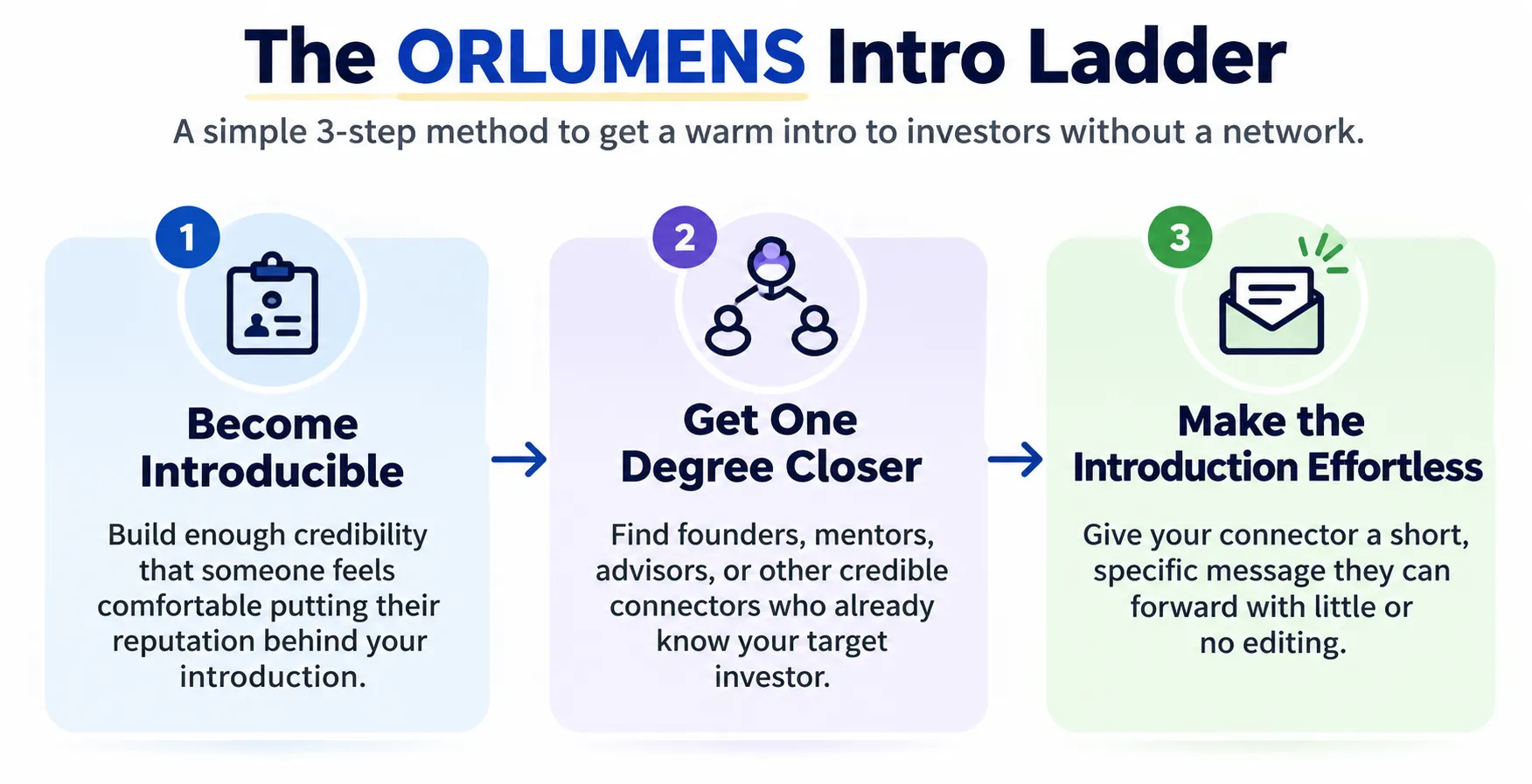
- Become introducible: Build enough credibility that someone feels comfortable putting their reputation behind your introduction.
- Get one degree closer: Find founders, mentors, advisors, community leaders, or other credible connectors who already know your target investor.
- Make the introduction effortless: Give your connector a short, specific message they can forward with little or no editing.
What Is a Warm Introduction to an Investor?
A warm introduction to an investor is a referral made by someone the investor already knows, trusts, or has worked with. Instead of contacting the investor completely cold, a founder reaches them through a mutual connection who can provide context, establish initial credibility, and explain why the conversation may be worth having.
Getting a warm intro without a network does not mean finding an investor through a close friend or existing investor contact. It means deliberately building a path through second-degree connections.
Those connections might include portfolio founders, mentors, advisors, accelerator managers, lawyers, accountants, angel investors, community leaders, or people active in professional networks.
The goal is not to collect hundreds of contacts. It is to identify a relevant investor, find someone who has a credible relationship with that investor, and give that person a clear reason to make the connection.
A strong warm introduction usually answers three questions quickly:
Who is the founder? Why is the company relevant? Why should this investor care now?
Do Warm Introductions Work Better Than Cold Emails?
Warm introductions can be more effective than cold emails because the outreach arrives with context and some degree of trust from an existing relationship. The British Business Bank describes warm approaches as introductions through people an investor trusts and notes that cold approaches are typically less effective.
Stripe similarly notes that warm introductions can convert at higher rates than cold outreach because they carry trust already established by the connector. However, published conversion figures vary by source, dataset, stage, and investor type, so founders should treat headline numbers as directional rather than universal.
That does not mean cold email should be avoided.
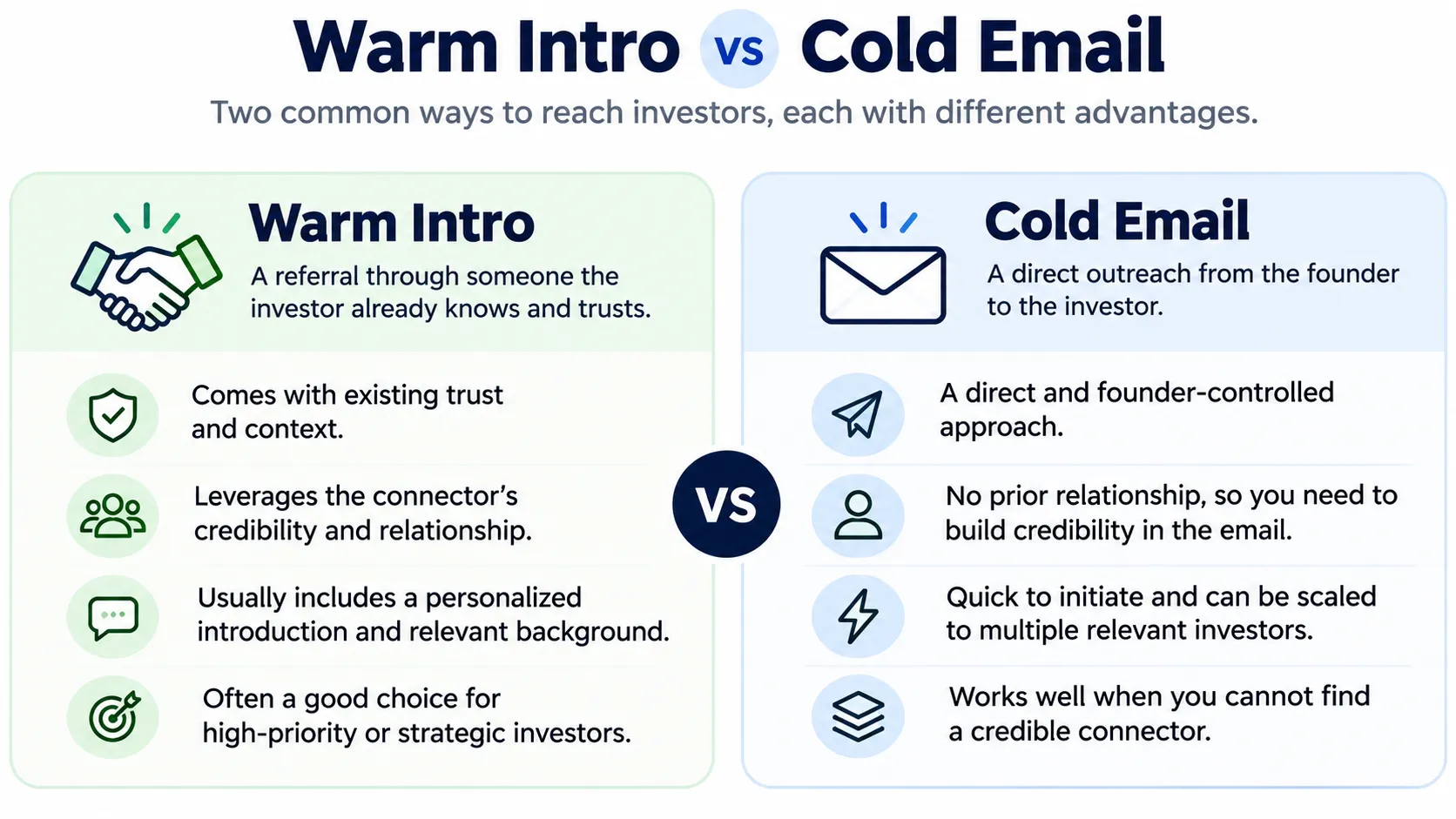
Y Combinator’s Michael Seibel has explicitly advised founders not to spend excessive time chasing warm introductions when a concise, relevant direct email could start the conversation.
The practical difference is trust transfer. In a warm introduction, some credibility comes from the connector. In a cold email, the founder has to establish that credibility from scratch.
Use a warm introduction when you can earn one—but do not stop fundraising simply because you do not have one.
Why Emerging-Market Founders Face a Bigger Networking Challenge
Emerging-market founders can face an additional challenge: they may operate farther from established venture-capital hubs, investor communities, accelerators, and repeat relationships through which opportunities are discovered.
This does not mean strong startups only exist in major investment centers. It means access to capital, expertise, and professional networks can be uneven.
IFC says early-stage entrepreneurs in nascent venture ecosystems can face significant challenges accessing the capital and expertise required to grow. Its venture-capital initiatives across Africa, the Middle East, Central Asia, and Pakistan combine investment with access to networks, sector knowledge, accelerators, and local-market expertise.
Africa provides one example of how geographically concentrated venture ecosystems can become. AVCA’s 2025 data shows that investor participation and venture activity remain concentrated around established markets and investor bases, even as international investors participate across the continent.
Networking is only one part of this wider access challenge, but relationships matter because a credible mentor, founder, advisor, accelerator, or ecosystem operator can become the bridge between a promising company and an investor who might otherwise never encounter it.
Who Can Introduce You to an Investor?
The best person to introduce you to an investor is someone the investor already knows and respects. You do not need the most famous connector. You need a relevant one who can credibly explain who you are, what you are building, and why the introduction makes sense.
- Portfolio founders: Founders already backed by the investor may understand the investor’s thesis, preferences, and working style.
- Mentors and advisors: Experienced operators and industry advisors may have relationships with angels, venture funds, or family offices.
- Accelerator and incubator leaders: Program managers often interact with investors and may introduce founders whose businesses show relevant progress and fit.
- Professional service providers: Startup lawyers, accountants, and corporate advisors can sometimes connect founders to investors within their professional networks.
- Community and network leaders: Founder communities, event organizers, industry groups, and trusted networking platforms can help founders move one degree closer to relevant investors.
The British Business Bank specifically recommends looking to entrepreneurs, lawyers, accountants, existing contacts, and professional networks for potential investor introductions.
The key is relevance, not status.
A connector who genuinely understands your company and has a real relationship with the investor is more useful than a high-profile person who barely knows them.
Founders in Pakistan can also explore ORLUMENS’ Investor Connections initiative when looking to expand their access to relevant founders, investors, and business leaders.
The ORLUMENS Intro Ladder: 3 Steps to a Warm Intro Without a Network
The ORLUMENS Intro Ladder is an editorial framework created by ORLUMENS to help founders systematically build a path toward an investor introduction.
Instead of trying to “network with investors” randomly, it creates a simple progression:
Become introducible → Get one degree closer → Make the introduction effortless.
Step 1: Become Introducible
Before asking anyone for a warm introduction, make sure you are easy to understand, verify, and recommend.
A connector is not simply forwarding your name. They are attaching some of their own credibility to the introduction.
Your startup therefore needs to look prepared before you ask someone to open a door.
Start with:
- A clear LinkedIn profile explaining who you are
- A concise one-line description of your startup
- A credible website, product page, or online presence
- Evidence of traction where available
- Relevant customer, revenue, pilot, partnership, or user-growth signals
- A clear fundraising stage and amount
- A specific reason for approaching that investor
The goal is not to make your business appear larger than it is. The goal is to remove unnecessary uncertainty.
If someone asks your connector, “Why did you introduce this founder?”, they should have a credible answer.
You become introducible when your story is clear, your company is easy to verify, and the investor fit is understandable.
Step 2: Get One Degree Closer
Once your profile is ready, stop searching broadly for “investors.”
Choose a specific investor.
Then work backward.
Ask:
Who already knows this investor and is realistically accessible to me?
That person could be a portfolio founder, mentor, advisor, accelerator manager, angel investor, lawyer, accountant, startup consultant, business leader, or industry contact.
Do not assume the best connector is the person with the biggest profile.
The best connector is usually someone who:
- actually knows the investor,
- understands enough about your company to judge the fit, and
- feels comfortable attaching their name to the introduction.
Avoid opening with:
“Can you introduce me to investors?”
Build context first.
Ask a thoughtful question. Discuss the investor’s thesis. Explain why you believe there is a fit. Share a concise company update. Give the person enough information to form their own view before requesting access to their network.
For founders building their broader professional network, ORLUMENS’ CEO Networking initiative is another relevant pathway for developing relationships with founders, executives, investors, and decision-makers.
The purpose of Step 2 is simple:
Move from zero relationship to one trusted relationship away.
Step 3: Make the Introduction Effortless
When someone agrees to help, do not make them create your pitch.
Give them everything required to make the introduction with minimal effort.
A strong forwardable introduction should normally contain:
- Your name and company
- What the company does
- Your strongest proof point
- What you are raising
- Why this particular investor is relevant
- A simple request for a conversation
Keep it short.
Your connector should not have to rewrite your company story, search for your website, ask what you are raising, or guess why the investor should care.
Instead of:
“Please introduce me to this investor. We are building something exciting.”
Give them a precise summary explaining the opportunity and the fit.
Stripe similarly recommends providing connectors with a short forwardable blurb and mapping shared relationships before requesting an introduction.
Respect the double opt-in. Your connector may first ask the investor whether they are open to the introduction before connecting both parties. This protects the connector’s relationship with the investor and avoids putting either side in an uncomfortable position.
The easier you make the introduction, the less friction you create for both sides.
That is the core of the ORLUMENS Intro Ladder:
Become introducible → Get one degree closer → Make the introduction effortless.
A warm introduction is not simply something you either “have” or “do not have.” A founder with no established investor network can deliberately build a credible path one relationship at a time.
Intro Ladder Example: How a Lahore Founder Could Use It
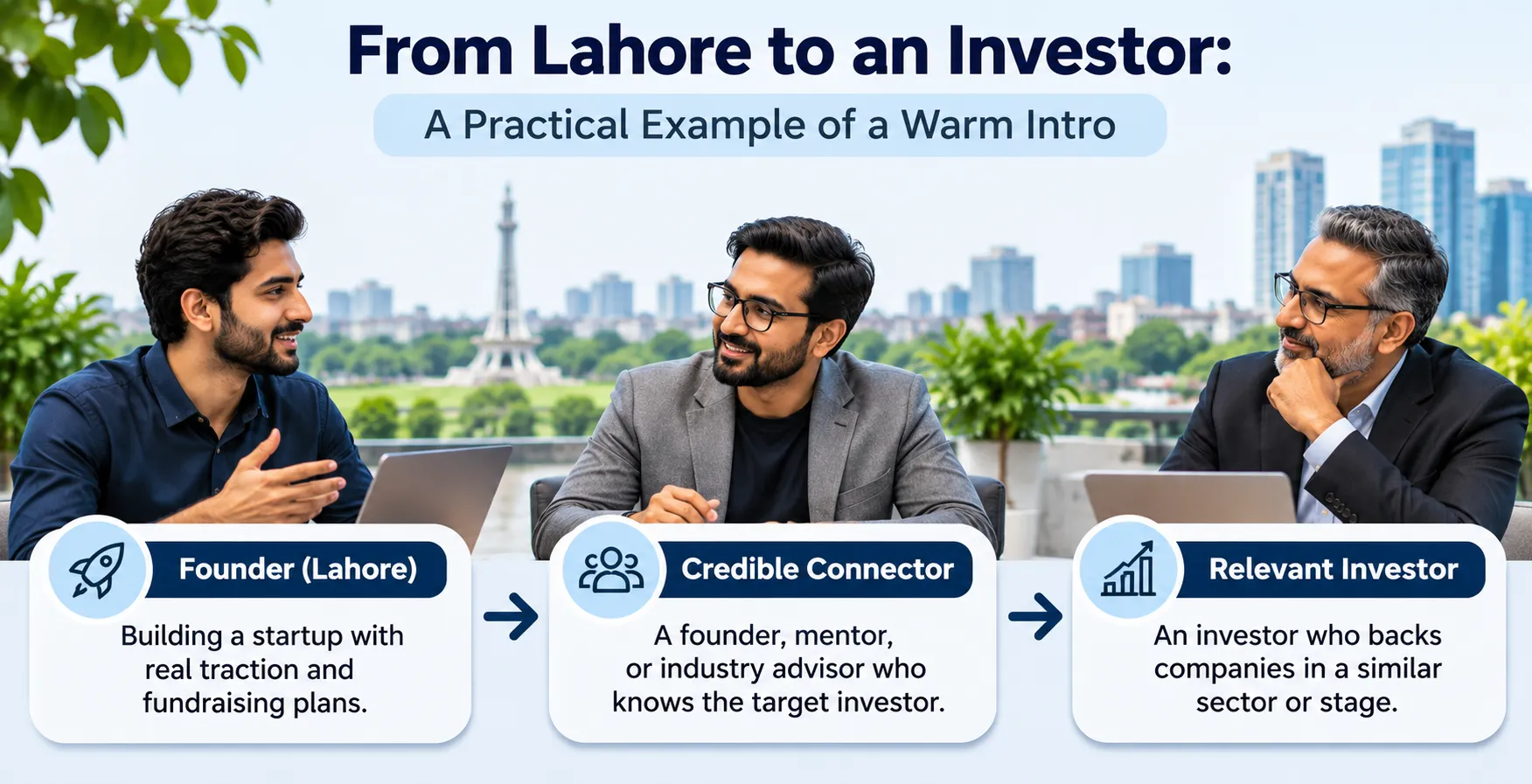
Example (illustrative, not a real company):
Ali is a founder in Lahore building BazaarPay, an app that helps small shopkeepers track daily sales and credit. He has 120 shops using it, but he knows no investors.
Step 1: Ali updates his LinkedIn, adds a one-line description of BazaarPay, and writes down his proof: 120 active shops.
Step 2: He finds that an angel investor, Sara Khan, backed a similar startup. He messages that startup’s founder, Hamza, and asks for advice on fundraising. After two chats, Hamza knows Ali’s business well.
Step 3: Ali asks Hamza if he would introduce him to Sara and sends a short, ready-to-forward message. Hamza forwards it in two minutes.
How to Find Someone Connected to Your Target Investor
Finding a warm path to an investor starts by mapping who already has a meaningful relationship with them. Instead of asking everyone you know for “investor introductions,” work backward from one specific investor and identify the shortest credible path.
- Study the investor’s portfolio.
Look at companies the investor has already backed, particularly founders operating in your sector, stage, geography, or adjacent market. - Check mutual and second-degree connections.
Use LinkedIn, accelerator networks, founder communities, event pages, professional groups, and your existing contacts. - Look beyond founders.
Advisors, lawyers, accountants, angels, industry leaders, accelerator managers, and even trusted customers may have relevant relationships. - Prioritize relationship quality over status.
A respected operator who regularly speaks with the investor is more valuable than a famous contact who has only met them once. - Approach with context.
Explain why you are interested in that specific investor and why you believe there is a fit. When possible, begin by asking for perspective rather than immediately demanding an introduction.
The goal is not to build the biggest network.
It is to discover the shortest credible path to the right investor.
Investor Introduction Email Template (Copy-Paste)
A good investor introduction request should be short, specific, and easy to forward. Do not make the connector rewrite your pitch or guess why the investor is relevant.
Template 1: Message to the Connector
Hi Hamza,
I saw that you know Sara Khan. I’m building BazaarPay, which helps small shopkeepers in Pakistan track daily sales and credit.
We have 120 active shops and are raising $150,000 (pre-seed).
I think Sara could be a good fit because she backed a retail-tech startup last year. If you think the fit makes sense, would you be comfortable introducing us? I’ve added a short note below to make it easy.
Template 2: Forwardable Investor Blurb
Hi Sara,
I’d like to introduce you to Ali Raza, founder of BazaarPay. They’re building a sales and credit tracking app for small shopkeepers in Pakistan.
They have 120 active shops and are raising $150,000 (pre-seed). I thought of you because of your interest in retail technology.
Ali would value a short conversation to see if there’s a fit.
This is an illustrative example. Names and numbers are not real.
The best introduction requests are personalized. Replace every placeholder with a real reason, proof point, or investor-fit signal before sending.
Also avoid placing confidential customer information, proprietary data, or sensitive financial details in a forwardable message unless you are comfortable with that information being shared.
Warm Intro vs Cold Email vs Events vs Networking Platforms
No single investor-outreach channel is best in every situation. Warm introductions generally provide stronger initial trust, while cold email gives founders more direct control. Events are better for relationship-building, and networking platforms can help expand the pool of potential connectors.
| Approach | Initial trust | Effort | Time to initiate | Best for |
|---|---|---|---|---|
| Warm intro | High | Medium | Medium | Reaching a specific high-priority investor |
| Cold email | Low initially | Low-Medium | Fast | Reaching a relevant investor when no connector exists |
| Events | Medium | High | Slow | Developing relationships and expanding your network |
| Networking platforms | Medium | Medium | Medium | Discovering investors, founders, mentors, and connectors |
These are general comparisons rather than guaranteed outcomes. Results depend on the investor, company stage, relationship quality, timing, and relevance of the outreach.
A practical fundraising strategy often combines several channels. Try to earn warm introductions for high-priority investors, but do not leave a strong investor untouched indefinitely simply because you cannot find a connector.
5 Mistakes That Kill Investor Introduction Requests
Even a strong company can lose a potential introduction if the request creates unnecessary work or puts the connector in an uncomfortable position.
- Making a generic ask.
“Can you introduce me to investors?” gives the connector no target, context, or reason to act. - Sending a long pitch.
The connector does not need your entire story. Give them a concise, forwardable summary. - Ignoring investor fit.
Do not request an introduction merely because someone has access. Explain why that specific investor matches your sector, stage, geography, or business model. - Asking before building credibility.
Give the connector enough information to understand your company and feel comfortable recommending you. - Following up aggressively.
A polite follow-up can be reasonable. Repeated pressure can damage the relationship you’re trying to build.
A good introduction works when the founder, connector, and investor all have a clear reason for the conversation to happen.
How Can Pakistani Founders Get Investor Introductions?

Pakistan illustrates why investor access and relationship-building can matter in an emerging venture ecosystem.
The government-backed Pakistan Startup Fund (PSF) is an initiative under Pakistan’s Ministry of IT & Telecom and is executed by Ignite National Technology Fund. According to the official program information, eligible early-stage Pakistani startups can receive a non-equity grant of up to 30% of the total investment round size, subject to the program’s eligibility and approval requirements.
Importantly, PSF does not replace private investors.
Eligible startups must already have secured, or be in advanced stages of securing, private investment through instruments such as a term sheet, funding agreement, or letter of intent.
That creates a practical connection between investor readiness and access:
Founder → credible connector → relevant investor → potential funding conversation
The official PSF framework reinforces an important point for Pakistani founders: government support and private investment can complement each other, but founders still need to identify suitable investors and build credible fundraising relationships.
For a broader walkthrough of investor discovery and fundraising preparation, see ORLUMENS’ guide to startup funding in Pakistan.
ORLUMENS can also help founders expand their professional network through introductions, investor connections, networking, and its wider business ecosystem.
ORLUMENS facilitates introductions and business connections but does not guarantee funding, investment, meetings, or any particular outcome. All investment decisions remain between the founder and the relevant investor or investment organization.
FAQs
How do I get a warm intro to an investor if I have no network?
Start with one relevant investor and work backward to people they already know. Portfolio founders, mentors, advisors, accelerators, community leaders, lawyers, and professional networks can become connectors. Build enough credibility for someone to feel comfortable recommending you, then give them a concise, forwardable introduction request.
What Is a Good Cold Email Template for Investors?
If you cannot find a credible warm introduction, here is a concise cold-email example:
Subject: BazaarPay: sales tracking app for 120 Pakistani shops
Hi Sara,
I’m Ali, founder of BazaarPay. We help small shopkeepers in Pakistan track daily sales and credit.
We have 120 active shops and are raising $150,000 (pre-seed). I’m reaching out because you backed a retail-tech startup last year.
Would you be open to a 15-minute call? I can send a short deck first if you prefer.
Thanks,
Ali Raza
Do cold emails to investors actually work?
Yes. A targeted cold email can work when it clearly explains what you are building, why it matters, and what you want. Y Combinator advises founders to keep investor emails concise and direct, and warns against spending excessive time chasing introductions when direct outreach could start the conversation.
What is a warm intro in startup fundraising?
A warm intro occurs when someone who already has a relationship with an investor introduces a founder to them. The connector gives the investor context before the founder reaches out directly. That can reduce uncertainty, but it does not guarantee a meeting, due diligence, investment, or a positive response.
How do I ask someone to introduce me to an investor?
Ask about one specific investor rather than requesting access to “any investors.” Briefly explain why the investor fits your company, give your strongest proof point, state what you are raising, and provide a short forwardable blurb. The easier the request is to understand and forward, the easier it is for the connector to act.
Can founders in emerging markets reach global investors?
Yes. Emerging-market founders can reach international investors through direct outreach, accelerators, portfolio founders, advisors, professional communities, industry events, and trusted introductions. The key is targeting investors whose stage, sector, geography, and investment thesis align with the company rather than approaching investors indiscriminately. IFC actively supports venture ecosystems spanning emerging markets, including Pakistan.
How long does it take to get a warm intro to an investor?
There is no universal timeline. The process depends on whether you already know a credible connector, how strong that relationship is, investor availability, and how prepared your request is. Some introductions can happen quickly; building the relationship that makes an introduction credible may take considerably longer.
Should I pay someone for an investor introduction?
Be cautious about paying solely for access to an investor, especially when someone promises guaranteed meetings or funding. Legitimate accelerators, advisors, consultants, or networking platforms may charge for broader services, but payment should never be interpreted as a guarantee that an investor will respond, meet, conduct due diligence, or invest.
Conclusion
You do not need to begin with a powerful investor network to create a credible path to one.
Start by becoming introducible. Identify the right investor. Get one trusted relationship closer. Then make your introduction request so relevant and easy to forward that the connector does not have to build your pitch for you.
If you want to expand your access to founders, CEOs, business leaders, mentors, and investor connections, you can explore the ORLUMENS ecosystem and become part of the network.
ORLUMENS facilitates professional connections and introductions but does not guarantee funding or investment outcomes.
About the Author
Noor ul Hassan
Noor ul Hassan writes for ORLUMENS, Pakistan’s networking and business intelligence ecosystem for founders, CEOs, investors, and business leaders. He writes about business networking, founder stories, startup funding, and investor access, with a focus on helping founders in Pakistan and other emerging markets build the relationships that growth depends on. His ORLUMENS guides include How to Find Investors & Get Startup Funding in Pakistan.
Follow ORLUMENS on LinkedIn
Sources
- How to make the first approach to an investor — British Business Bank
- How to reach out to investors for your startup: Cold emails, warm intros, and follow-ups — Stripe
- How to Find Investors for Your Startup — Stripe
- How to Email Early-Stage Investors — Y Combinator
- Venture Capital — International Finance Corporation (IFC)
- 2025 Venture Capital in Africa Report — African Private Capital Association (AVCA)
- Pakistan Startup Fund — Ministry of IT & Telecom, Government of Pakistan
- Pakistan Startup Fund — Ignite National Technology Fund